
Standard vs. White-Label Ad Servers: Which Is Right for Your Business?
Introduction
Ad servers sit at the heart of digital advertising operations, powering everything from basic banner delivery to complex, multi‑channel programmatic strategies. The platform you choose determines how much control you have over inventory, data, and revenue, which is why the standard‑versus‑white‑label decision has become a strategic question rather than a purely technical one.
Standard ad serving platforms promise quick setup and proven workflows, while a white-label ad server offers deeper control, customization, and brand ownership. Understanding how these options differ—and where each makes sense—helps publishers, hi‑tech ad networks, and platforms avoid costly replatforming and unlock better monetization over the long term.
What is a standard ad server?
A standard ad server is a ready‑to‑use platform managed within a provider’s ecosystem, typically offered as a SaaS product. It comes with predefined features for ad delivery, targeting, reporting, and campaign management, all accessed via the vendor’s interface and branding.
These ad server platforms are designed for faster onboarding with limited configuration and minimal engineering effort. You adopt the vendor’s default workflows and ad serving tools, connect a handful of demand partners or direct campaigns, and start serving ads without building your own infrastructure. For smaller teams or those new to programmatic, this simplicity can be a major advantage.
What is a white-label ad server?
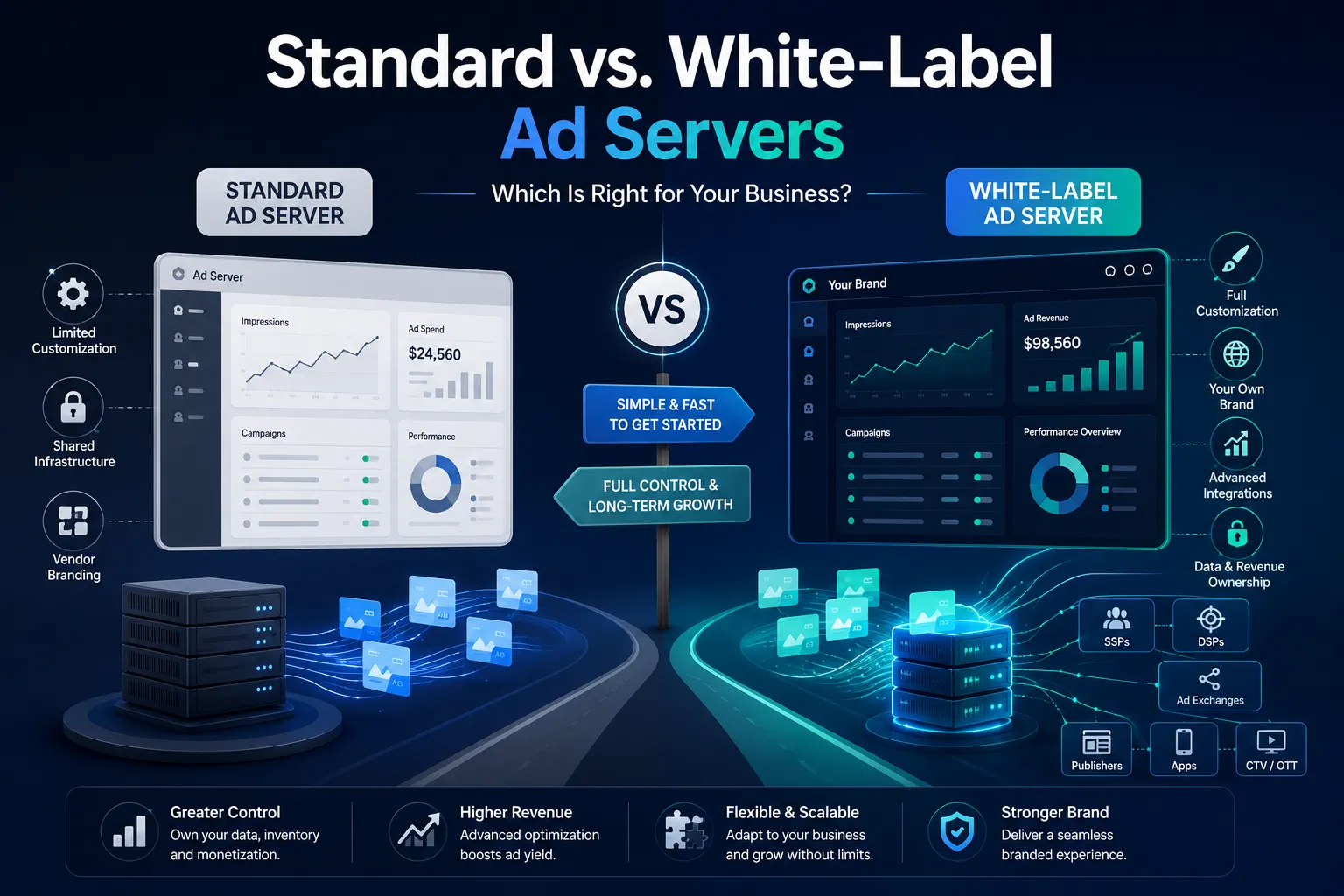
A white-label ad server is a customizable ad serving platform that you run under your own brand, often on your own domain, while leveraging the vendor’s underlying infrastructure and technology. Instead of operating inside a third‑party UI, you have the option to tailor interfaces, workflows, and integrations to match your business model and partner ecosystem.
This type of white-label ad serving platform provides greater control over ad delivery, reporting, and monetization strategy. You can integrate multiple SSPs, DSPs, and exchanges, configure deal types, and define how data flows into your internal analytics or data warehouse. In practice, a white label ad platform lets you operate more independently while still benefiting from proven infrastructure instead of building everything from scratch.
Key differences between standard and white-label ad servers
Branding and ownership
Standard platforms keep the vendor’s branding front and center, with customers logging into a shared interface and working within shared UX patterns. A white-label ad server gives you full brand control and the ability to create custom environments for publishers, advertisers, and internal teams. This is especially valuable for hi‑tech ad networks that want to position their platform as proprietary technology rather than “just another reseller.”
Customization and flexibility
With standard tools, features and workflows are largely predefined, and changes follow the provider’s roadmap, not yours. A white‑label ad serving platform supports tailored configurations—custom roles, unique reporting views, bespoke line item types, and specialized integrations for your vertical. This flexibility matters when your commercial model or partner mix deviates from what off‑the‑shelf platforms were built for.
Scalability
Standard solutions often scale well in terms of raw traffic but can become restrictive as operational complexity increases. Limits on integrations, data access, or feature customization may force you into workarounds as you add more publishers, channels, or markets. White‑label infrastructure, by contrast, is designed to support expansion: more traffic, more partners, and more complex setups without sacrificing performance or control.
Revenue optimization
Standard solutions typically provide baseline optimization features but limit how deeply you can tune auctions, prioritize demand, or customize reporting for ad revenue optimization. A white‑label ad serving platform usually unlocks more advanced strategies, such as dynamic floor pricing across different supply paths, intricate waterfall or header bidding setups, and granular experiments at the placement or audience level. This level of control can make a meaningful difference to long‑term yield, especially for sophisticated publishers and hi‑tech ad networks.
When a standard ad server makes sense
Standard platforms can be the right choice for organizations with simpler needs and limited internal resources.
They work well when:
- You are a smaller publisher or early‑stage business with straightforward monetization goals and a limited number of partners.
- Quick setup and low upfront costs matter more than deep customization or ownership.
- Your team does not have complex integration requirements and can operate effectively within pre‑built workflows.
In these cases, a standard ad server can provide a reliable foundation and allow you to prove out your model before investing in more advanced infrastructure.
When a white-label ad server is the better choice
A white-label ad server becomes more attractive as your operations grow in scale, complexity, or strategic ambition.
It is usually the better fit when:
- You are a growing ad network or large publisher group managing multiple sites, apps, or channels.
- Your business requires full control over monetization logic, partner mix, and data access to stay competitive.
- You plan to scale across markets or formats—such as web, mobile app, CTV/OTT, or retail media—and want a unified, extensible stack.
- Your team needs custom integrations and workflows that standard platforms cannot easily support.
For hi‑tech ad networks in particular, a white-label ad serving platform is often essential to differentiate their offering, run proprietary optimization, and maintain margin as they add partners and traffic.
Cost considerations
At first glance, standard ad servers typically offer simpler, more predictable pricing models, such as flat fees or volume‑based CPM charges. White‑label solutions tend to require a larger investment—either in platform fees, implementation, or the internal resources needed to leverage their flexibility.
However, total value depends on how well the platform supports scalability and operational efficiency. If a standard tool forces you into manual work, limits your optimization options, or restricts your ability to onboard new partners, apparent short‑term savings can translate into lost revenue and higher hidden costs. A white label ad platform that enables deeper ad revenue optimization and automation may generate significantly better ROI over time, especially for larger operations.
Best practices for making the right choice
To choose between a standard and white-label ad server, approach the decision as a strategic platform selection rather than a simple feature comparison.
- Align capabilities with business goals. Map platform strengths to your revenue model, partner strategy, and product roadmap instead of choosing based solely on current needs.
- Consider both short‑term and long‑term scalability. Think about how many publishers, channels, and integrations you expect to manage in the next three to five years.
- Evaluate reporting, integrations, and optimization tools carefully. These are the levers you will use daily for ad revenue optimization, so they matter more than cosmetic features.
- Prioritize transparency and operational control. Ensure you can see how auctions run, how fees are applied, and how data flows—especially if you intend to build proprietary analytics or pricing strategies.
A structured evaluation process makes it easier to justify your choice internally and reduces the risk of having to replatform as your business grows.
Conclusion
Standard and white‑label ad servers are built for different stages and ambitions of a business. Standard platforms offer a fast, low‑friction way to get started with digital advertising, while a white-label ad serving platform provides the ownership, flexibility, and depth needed to build a differentiated, scalable monetization engine.