The Hidden Integration Costs of RPA: What Vendors Don't Put in the Proposal
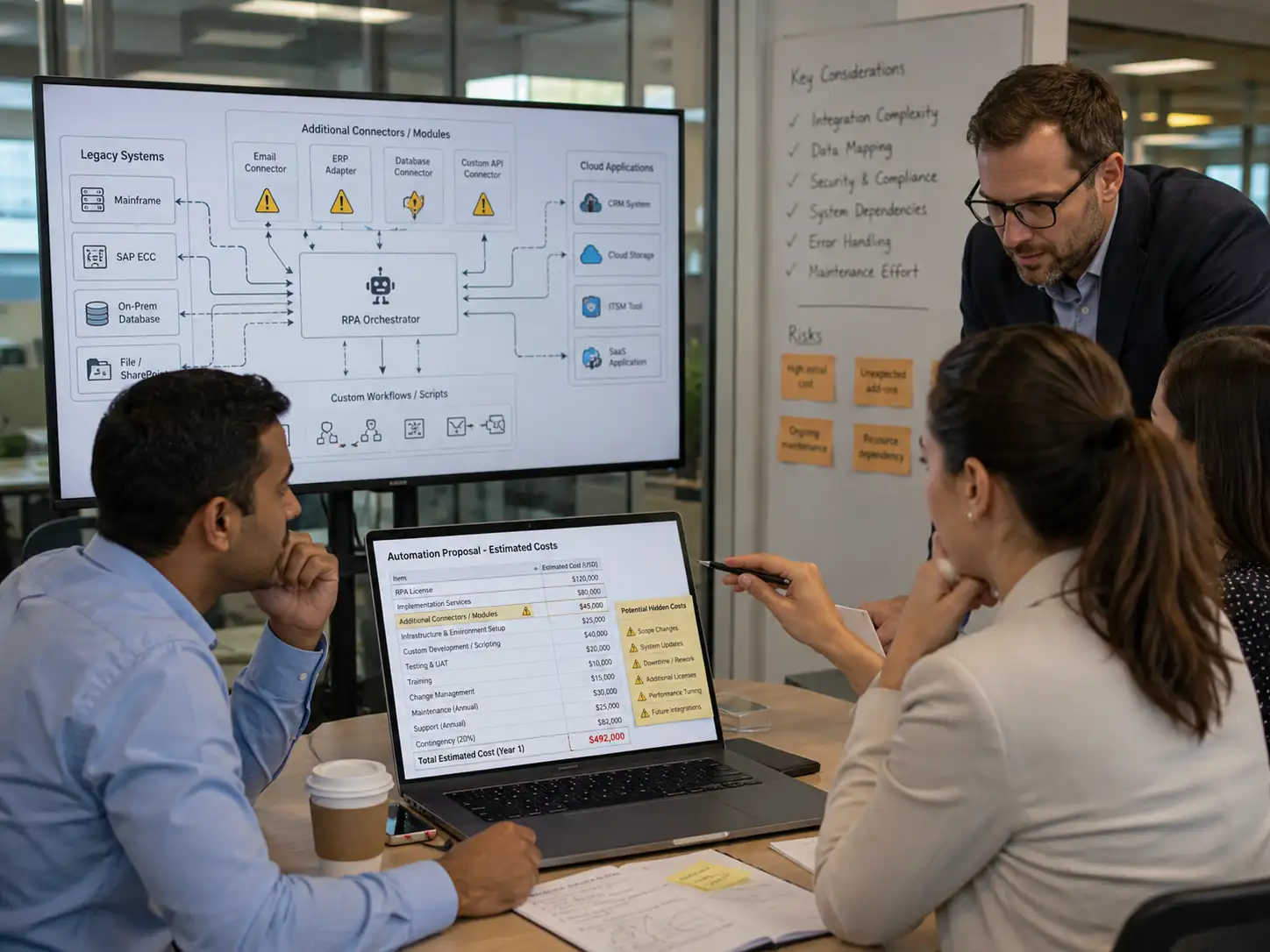
Every RPA proposal looks clean on paper. A license fee, a per-bot cost, a rollout timeline, a projected ROI. Then implementation starts, and the invoices that show up don't match the quote.
This isn't rare, and it isn't a sign that your team did something wrong. According to Gartner's peer research on failed automation initiatives, roughly half of RPA projects fail to deliver on their original business case, and a large share of that gap traces back to costs nobody priced into the original proposal: integration work, exception handling, change management, and ongoing maintenance. Forrester's research points to a similar pattern, finding that many RPA rollouts stall once real-world process variability exceeds what the original bots were built to handle.
None of this means RPA is a bad bet. It means the proposal you're looking at is describing the software, not the project. This guide walks through where the hidden costs actually come from, how to spot them before you sign anything, and what a realistic budget and timeline look like once integration is priced in honestly.
What "Integration Cost" Actually Means in RPA
Integration cost is everything required to make a bot work reliably inside your existing systems, beyond the license fee for the automation software itself.
Vendors quote the software. They rarely quote the surrounding work: connecting the bot to your ERP, CRM, or legacy systems; handling the UI changes that break brittle scripts; building exception paths for the messy 20% of cases that don't follow the happy path; and maintaining all of it as your systems get patched, updated, or replaced.
Integration cost vs. license cost
License cost is a subscription: attended or unattended bot seats, usually billed per bot per year. Integration cost is labor: process discovery, custom connectors, testing, and the fixes needed when a bot breaks because a vendor pushed a UI update. Industry cost breakdowns put licensing at roughly 25–30% of total RPA spend, with the remainder going to implementation, integration, and ongoing maintenance. That ratio is the single most misunderstood number in most vendor conversations.
Why proposals under-price it
Sales-stage proposals are usually scoped against a "representative process" that a solutions engineer picked because it's clean and well-documented. Production processes are messier. They have exceptions, they touch systems with inconsistent data formats, and they change every time a department updates a workflow. A proposal built on the clean version of the process will always undercount the integration work the real version requires. Our own step-by-step guide to RPA implementation walks through where that discovery work actually belongs in the timeline.
When Hidden Integration Costs Are Most Likely to Hit You
Not every RPA project gets blindsided by integration costs. These are the situations where it's almost guaranteed.
You're automating a process that touches legacy systems
If any part of the process runs through a system without a modern API — an old ERP module, a mainframe screen, a homegrown internal tool — expect the bot to interact with the UI directly. UI-based automation is fragile by nature, and every future update to that legacy system is a future maintenance ticket.
Your process has more than one "version" depending on who runs it
If three different regional teams run a "single" process three slightly different ways, the vendor's demo bot was built for one of those versions. The other two are unbudgeted integration work.
You need the bot to talk to more than two or three systems
Each additional system the bot touches multiplies the number of things that can change underneath it. A bot connecting two systems is a project. A bot connecting five is closer to an integration platform, and should be priced and staffed like one.
Compliance or audit requirements sit on top of the process
Healthcare, finance, and insurance processes often need logging, access controls, and audit trails that go well beyond what an off-the-shelf bot ships with. That layer is almost never in the base proposal, and it's usually the point where a straightforward RPA build needs to graduate into a full hyperautomation approach that layers AI and monitoring on top of the base bots.
Your organization plans to scale the bot beyond the pilot
A pilot bot handling one team's volume behaves very differently once it's running enterprise-wide. Infrastructure, monitoring, and support costs scale with usage in ways a pilot-stage quote won't reflect.
Benefits of Pricing Integration Honestly From Day One
Budgeting for integration cost upfront isn't just about avoiding surprises. It changes the outcome of the project.
Fewer stalled deployments. Projects that price in integration and change management from the start are far less likely to join the roughly 50% of RPA initiatives that Gartner and EY both report failing to scale past pilot stage.
Realistic ROI timelines. Nadcab's RPA cost-breakdown research puts typical break-even for a mid-sized deployment between 6 and 18 months depending on complexity — a number that only holds if integration costs were part of the original budget, not a surprise added later.
Lower long-term maintenance burden. Deloitte's research on automation change management found that 37% of RPA failures trace back to inadequate change management, not the technology itself. Budgeting for change management as an integration cost, rather than an afterthought, directly addresses that failure mode.
Better vendor accountability. When integration is scoped and priced explicitly, vendors have to commit to what "done" looks like, rather than leaving exception handling and legacy connectors as open-ended, billable-by-the-hour extras.
Smoother scaling from pilot to production. Programs that plan integration architecture for enterprise scale from the outset — rather than retrofitting a pilot — avoid the rework that eats into the reported 300–400% ROI that high-performing RPA programs achieve, according to industry benchmarking cited across multiple automation research firms.
RPA vs. the Alternatives: An Honest Comparison
RPA isn't the only path to automating a process, and it isn't always the cheapest one once integration is priced in.
RPA vs. native API integration. Where a system has a real, well-documented API, building a direct integration is usually more stable and cheaper to maintain long-term than a UI-based bot. The trade-off: API integrations take longer to build upfront and require more custom development, so they're a worse fit for a fast pilot or a system with no API at all.
RPA vs. low-code / no-code platforms. Low-code platforms can reduce the developer hours needed for simple workflows and are attractive for citizen-developer teams. The trade-off: they tend to hit a ceiling faster than custom RPA once a process involves several systems or complex exception logic, and moving off the platform later can mean a full rebuild.
RPA vs. AI-augmented or agentic automation. Adding AI/ML on top of rule-based bots lets automation handle unstructured input and judgment calls that classic RPA can't. Some research suggests failure rates for AI-augmented automation programs are meaningfully lower than for RPA alone. The trade-off: AI-augmented builds cost more upfront, need more careful governance, and are overkill for genuinely simple, stable, rules-based tasks.
The honest answer for most organizations is a mix: classic RPA for stable, high-volume rules-based work, and API integration or AI-augmented automation for the exception-heavy 20% that breaks brittle bots.
Who's Actually Involved in an Integration-Aware RPA Project
A proposal that only lists "an RPA developer" as project staff is a proposal that hasn't priced integration realistically. A properly staffed project usually includes:
- A business process analyst who documents the real version of the process, exceptions included, not the clean demo version.
- An RPA developer who builds and maintains the bots.
- An integration/backend engineer for any system without a clean API, and for connecting the bot to internal data sources securely.
- A change management or process owner on the client side, since Deloitte's research on failure causes points squarely at this role's absence.
- A QA/testing resource who tests against edge cases, not just the happy path.
- An ongoing support contact, internal or vendor-side, for when systems change post-launch.
Smaller pilots can compress some of these roles into one or two people. Enterprise-scale programs cannot skip any of them without inheriting the risk later.
A Realistic Step-by-Step Approach to Budgeting Integration Costs
Phase 1: Process discovery and exception mapping. Before any development starts, map the process as it's actually run, including every regional or team-level variation. Document exceptions and how often each one occurs. This phase is where most hidden costs get caught before they become invoices.
Phase 2: System and integration audit. Inventory every system the bot needs to touch. Flag which have modern APIs, which require UI-based automation, and which need custom connector work. This is the point to price legacy-system risk explicitly, rather than discovering it mid-build.
Phase 3: Pilot build with real-world exceptions included. Build the pilot against the messy version of the process, not the clean one. A pilot that only handles the happy path will pass its own demo and then fail in production.
Phase 4: Change management and rollout planning. Assign an internal process owner, train the teams whose workflows are changing, and set expectations for what the bot will and won't handle at launch.
Phase 5: Scaling and maintenance planning. Before scaling past the pilot, price out ongoing maintenance, monitoring, and the support model for when underlying systems change. This is where most proposals stop and most real costs begin.
What Actually Drives RPA Integration Pricing
A few honest variables determine why one RPA project costs far more than another with a similar bot count:
- Number and age of systems involved. Modern, API-first systems are cheap to integrate. Legacy or homegrown systems drive most of the labor cost.
- Process complexity and exception rate. A process with a 5% exception rate costs a fraction of one with a 30% exception rate, even if bot volume is identical.
- Compliance requirements. Healthcare and financial services processes carry audit, logging, and access-control requirements that add real engineering time.
- Geography of the delivery team. Delivery team location affects hourly rates significantly, though cheaper isn't automatically worse: the honest caveat here is that a lower-cost team with strong process discipline can outperform a premium-priced team that skips the discovery phase.
- Maintenance model. A fixed-scope build with no ongoing support is cheaper upfront and more expensive over three years than a build that includes a maintenance retainer, once you factor in the cost of bots breaking silently.
Why wait for the next system update to find out what your bot can't handle? A vendor that prices integration and maintenance transparently from the start is one you can actually plan a budget around.
Making the RPA Relationship Work Long-Term
Getting the pilot right is only the first stage. Three things separate programs that keep delivering value from ones that quietly stop working.
Treat the bot as a system that needs an owner, not a one-time deliverable
Every automated process needs someone on the client side responsible for knowing when the underlying systems change and flagging it before the bot breaks in production.
Build monitoring in from the start, not after the first outage
Bots that fail silently cost far more than bots that fail loudly. Basic monitoring and alerting should be part of the original scope, not a fix added after the first missed process run.
Revisit the exception list regularly
Processes drift. The exception list that covered 95% of cases at launch may cover 80% a year later. Scheduling a periodic review keeps the automation aligned with how the business actually runs, rather than how it ran at go-live.
Working with a robotic process development company that treats integration, exception handling, and change management as core deliverables — not optional add-ons — is usually what separates the RPA programs that scale from the ones that stall at pilot stage.
Conclusion
The number on an RPA proposal is real, but it's rarely the whole cost. Integration work, exception handling, change management, and maintenance are what turn a demo bot into a production system, and vendors who don't price those in upfront are setting expectations that production reality won't meet. Budgeting for them from the start is what separates automation programs that keep delivering value from the roughly half that stall before they scale.
Frequently Asked Questions
Is RPA still worth it if integration costs are this unpredictable? Yes, for the right processes. The unpredictability comes from under-scoped proposals, not from RPA itself. A properly scoped process discovery phase removes most of the guesswork before you sign anything.
How much more should I actually budget beyond the license quote? It varies by process complexity, but treating the license fee as roughly a quarter to a third of total project cost, with the rest going to implementation, integration, and maintenance, is a more realistic starting assumption than most proposals suggest.
Can a pilot project predict what full-scale rollout will cost? Only if the pilot includes the messy, exception-heavy version of the process. A pilot built only around the clean happy-path scenario will underestimate scaling costs significantly.
What's the biggest single cause of RPA projects going over budget? Under-documented process exceptions and legacy-system integration work that wasn't scoped during the sales conversation.
Do we need a dedicated internal team to maintain bots after launch? Not necessarily a full team, but you do need a named owner responsible for flagging system changes before they break automated processes.
Is it cheaper to build custom integrations instead of using an RPA platform? Sometimes. Where a system has a solid API, custom integration can be more stable and cheaper long-term. Where it doesn't, RPA's UI-based approach is often the only practical option.
How do we know if our process is too complex for RPA? If the process requires judgment calls, handles highly unstructured input, or has more exception paths than standard paths, RPA alone is likely a poor fit; AI-augmented automation is worth evaluating instead.
Does outsourcing development to a lower-cost region increase integration risk? Not inherently. Delivery cost and delivery quality are separate variables. Rate is a poor proxy for the discipline a team brings to process discovery and exception mapping.
What should be in an RPA proposal that most vendors leave out? A documented list of process exceptions and how each will be handled, a system-by-system integration plan, a named change management approach, and a maintenance model with a real cost attached.
How long before hidden integration costs typically show up? Usually within the first one to three months of production use, once real process volume and variability hit the bot in ways the pilot didn't.