Why AI-Powered Fitness Apps Are Vital for Modern Sports Businesses in 2026
The global sports and wellness landscape is undergoing a profound digital transformation. As we navigate through 2026, the traditional brick-and-mortar model of gyms, health clubs, and sports organizations is no longer sufficient to meet the evolving demands of tech-savvy consumers. The catalyst for this shift is Artificial Intelligence (AI). AI-powered fitness apps have transitioned from being a novelty to an absolute necessity. For modern sports businesses, integrating these advanced applications for the sports industry is the key to unlocking unprecedented growth, maximizing member retention, and maintaining a competitive edge in a multi-billion dollar market.This article delves into the critical reasons why sports businesses must embrace AI-driven fitness applications, backed by current market data, industry expertise, and real-world operational benefits.
The Exploding Market of AI in Fitness and Wellness
To understand the urgency of adopting AI fitness technology, one must look at the staggering market projections. The global fitness app market, which was valued at $12.12 billion in 2025, is projected to surge to $33.58 billion by 2033, expanding at a Compound Annual Growth Rate (CAGR) of 13.40% . Even more telling is the specific niche of AI in the fitness and wellness sector. This segment alone is predicted to reach an astonishing $57.80 billion by 2035 .These figures are not merely abstract projections; they represent a fundamental shift in consumer behavior. Users now expect highly personalized, data-driven, and accessible fitness experiences. Sports businesses that fail to provide these digital touchpoints risk obsolescence. The integration of AI into mobile applications allows clubs and trainers to extend their reach far beyond the physical confines of their facilities, creating a continuous, 24/7 engagement loop with their members.

Hyper-Personalization: The End of "One-Size-Fits-All"
Historically, gym memberships offered access to equipment, but little in the way of individualized guidance unless a member paid a premium for personal training. AI has democratized personalized fitness.Modern fitness apps utilize machine learning algorithms to craft dynamic, individualized workout routines. These programs are not static PDFs; they adapt in real-time based on a user's fitness level, equipment availability, past performance, and even daily fatigue levels . If an app detects a drop in performance or a user reports feeling overly tired, the AI can instantly recalibrate the intensity or suggest active recovery exercises.This level of hyper-personalization is a massive value proposition for sports businesses. It differentiates a premium club from a budget gym. When members feel that their unique physiological needs and goals are being met, their satisfaction skyrockets, directly impacting the lifetime value (LTV) of that customer.
Enhancing Performance and Preventing Injury
For sports clubs dealing with athletes, or gyms catering to serious fitness enthusiasts, injury prevention is paramount. AI is revolutionizing sports medicine and rehabilitation through advanced biomechanical analysis.By leveraging smartphone cameras or wearable sensors, AI can assess a user's form and movement quality in real-time. Computer vision technology detects posture errors, counts repetitions, and provides immediate corrective feedback . Furthermore, AI can analyze training load and intensity to flag high-risk scenarios before an injury occurs. According to recent industry reports, organizations implementing AI health monitoring have seen an 89% reduction in overtraining injuries and a 76% improvement in maintaining optimal training loads .For a sports business, reducing injury rates means fewer canceled memberships due to medical reasons and a reputation for prioritizing member safety and scientific training methods.
Transforming Gym Management and Operations
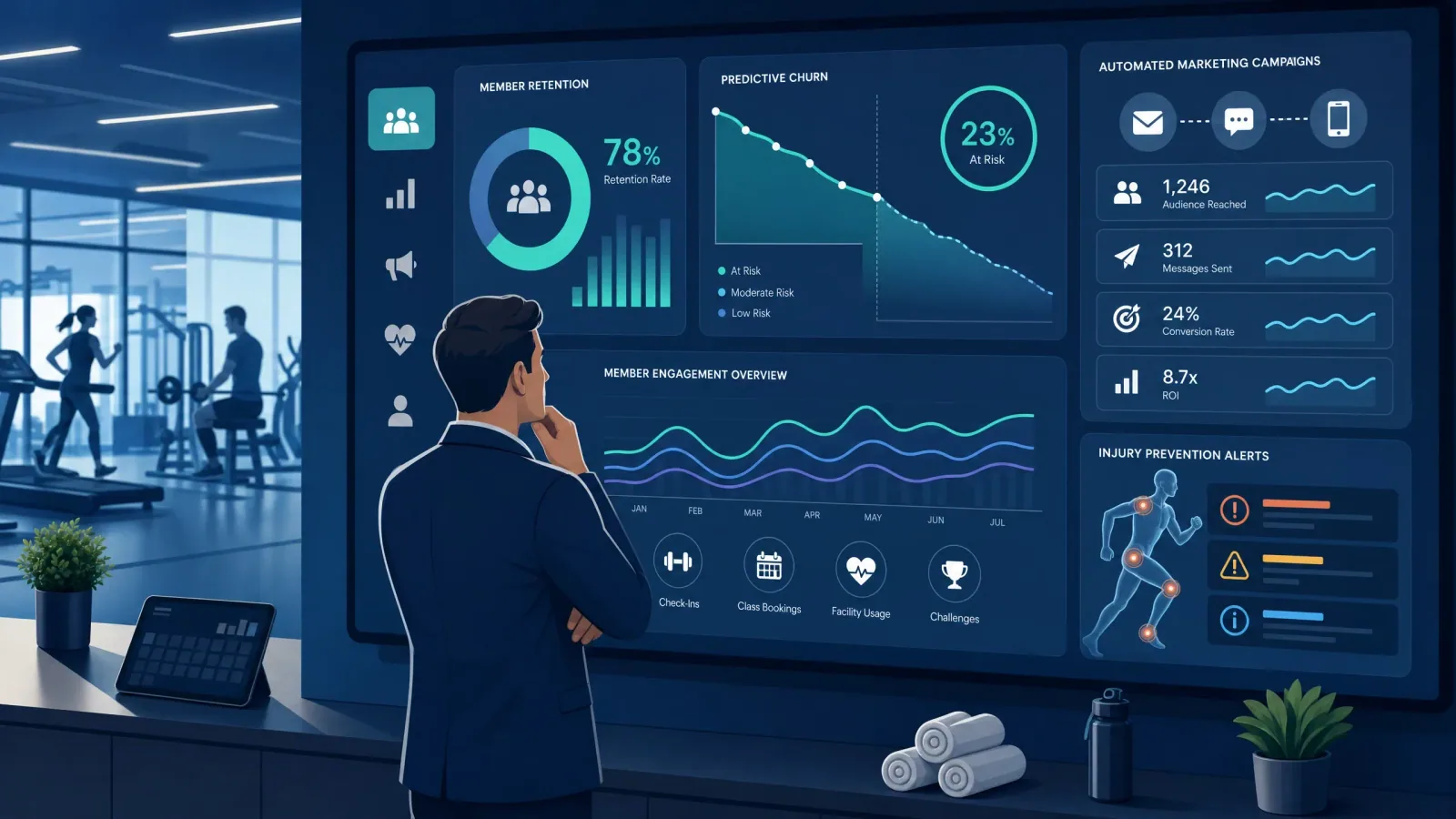
The benefits of AI applications extend far beyond the end-user experience; they fundamentally streamline the backend operations of sports businesses. Traditional gym management software focused on static record-keeping—logging memberships and processing invoices. Today's AI-native platforms are predictive and autonomous.
AI-Driven Member Retention
Member churn is the silent killer of sports businesses. Historically, clubs only analyzed churn after a member had already canceled. AI enables a proactive, predictive approach to retention.Advanced systems continuously monitor behavioral signals, such as:•Changes in attendance frequency•Missed or canceled bookings•Reduced engagement with club communicationsBy analyzing these signals holistically, AI can identify "at-risk" members long before they decide to quit. This allows the business to intervene with targeted re-engagement campaigns. Given that fitness studios utilizing advanced management techniques boast an average retention rate of 89% , the ROI of predictive AI is undeniable.
Intelligent Marketing Automation
AI also revolutionizes how sports clubs market their services. Instead of rigid, manual email blasts, AI marketing automation uses natural-language rules to create dynamic campaigns. The system analyzes attendance history and membership status to generate personalized messages . Whether it is re-engaging an inactive member or upselling a personal training package to a frequent visitor, AI ensures the right message reaches the right person at the optimal time, significantly boosting conversion rates.
Key AI Features Sports Businesses Must Implement
To successfully leverage AI, sports businesses should look for applications that offer a comprehensive suite of intelligent features. The following table outlines the most critical AI capabilities and their direct business benefits:
| AI Feature | Functionality | Business Benefit |
|---|---|---|
| Generative Workouts | Creates dynamic, adaptive training plans based on user data. | Increases premium subscription conversions and member satisfaction. |
| Motion Tracking (Computer Vision) | Analyzes form in real-time, providing corrective feedback. | Reduces injury rates and positions the brand as a premium, safety-first facility. |
| Predictive Analytics | Forecasts performance outcomes and identifies churn risks. | Drastically improves member retention rates and lifetime value (LTV). |
| Virtual AI Coaches | 24/7 chatbots for fitness advice and motivation. | Expands service capacity without increasing human headcount or payroll. |
| Automated Nutrition | Personalized meal planning and calorie estimation. | Provides a holistic wellness offering, increasing daily app engagement. |
Conclusion: The Cost of Inaction
In 2026, the question for sports businesses is no longer if they should invest in AI-powered fitness applications, but how quickly they can deploy them. The data is clear: AI drives personalization, enhances safety, automates complex marketing tasks, and fundamentally secures member retention.Developing or integrating a robust AI fitness app requires an upfront investment, but the cost of inaction is far greater. Sports clubs, gyms, and athletic organizations that fail to adopt these intelligent digital solutions will quickly find themselves outpaced by competitors who are using data to deliver superior, hyper-personalized fitness experiences. Embracing AI is the definitive strategy for building a resilient, profitable sports business in the modern era.