Why eLearning Platforms Are Becoming the Foundation of Modern Education and Corporate Training
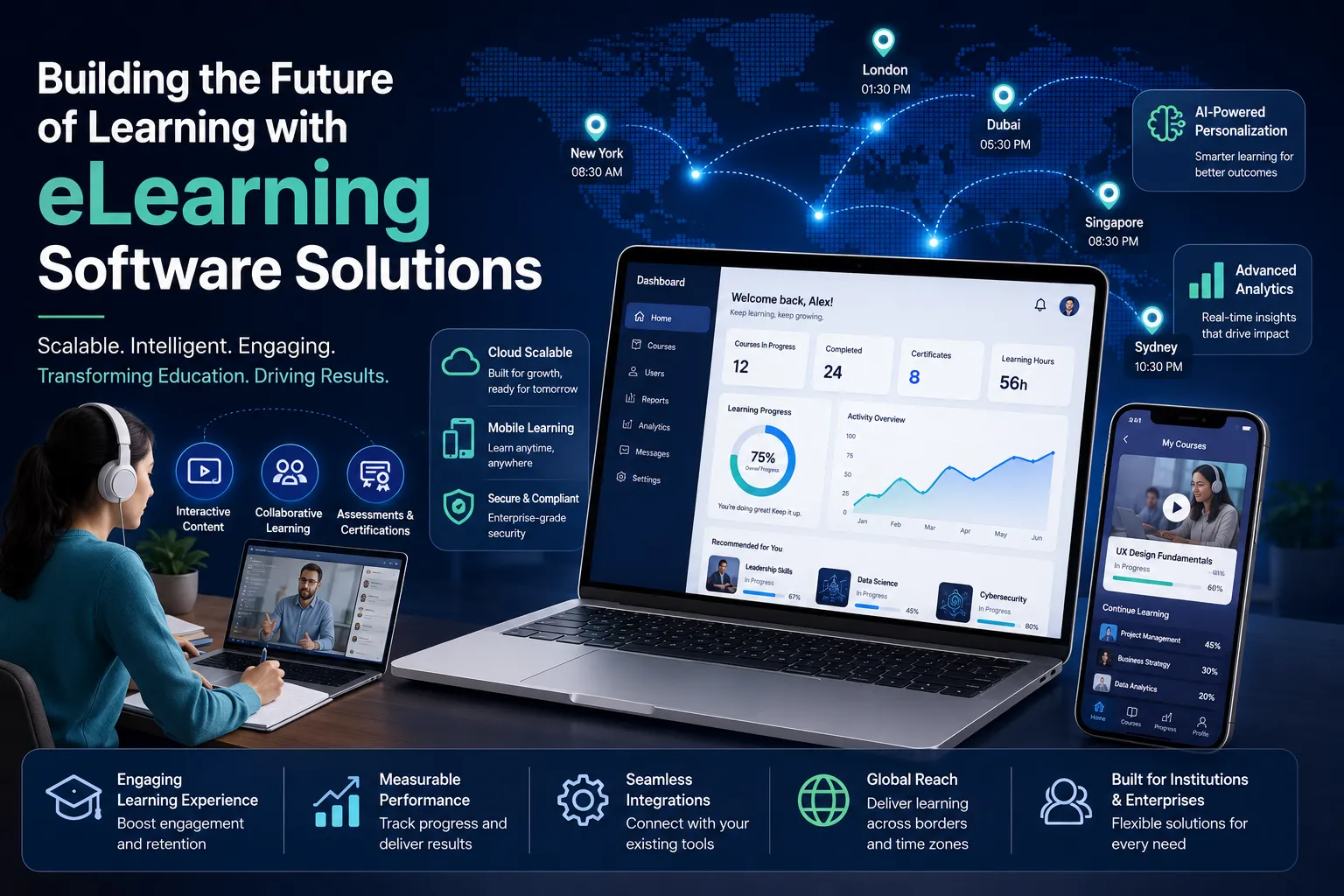
The way people learn has changed dramatically over the last decade. Traditional education models built around classrooms, fixed schedules, and static content are no longer enough for a world that moves faster every year. Businesses need employees to continuously upgrade their skills. Universities compete globally for digital learners. Training providers must deliver personalized experiences to thousands — sometimes millions — of users simultaneously.
This shift has transformed eLearning from a supplementary tool into a core business infrastructure.
Today, modern organizations are investing heavily in scalable digital learning ecosystems that combine cloud technologies, mobile accessibility, analytics, AI, and personalized learning experiences. eLearning platforms are no longer simple content repositories — they are intelligent systems that drive engagement, automate administration, improve learning outcomes, and create measurable business value.
As online education continues to expand across corporate training, higher education, K-12, and professional certification, organizations increasingly require flexible and scalable eLearning software development services provided by Aristek to build platforms that meet both technical and educational goals.
The future of learning is digital, adaptive, and deeply integrated into everyday business operations.
The evolution of eLearning: from static courses to intelligent ecosystems
Early eLearning systems focused primarily on digitizing educational materials. Companies uploaded PDFs, videos, and presentations into basic learning management systems with limited interactivity and minimal personalization.
Modern eLearning platforms operate very differently.
Today’s users expect seamless digital experiences similar to Netflix, Spotify, or modern SaaS applications. Learners want personalized recommendations, mobile access, interactive content, real-time feedback, and social learning capabilities. Organizations need analytics dashboards, compliance tracking, integrations with HR systems, and scalable infrastructure capable of supporting rapid growth.
As a result, eLearning platforms are evolving into fully connected ecosystems that combine:
- learning management systems (LMS)
- learning experience platforms (LXP)
- AI-powered personalization
- analytics and reporting
- mobile learning applications
- content authoring systems
- video learning infrastructure
- assessment and certification tools
This transformation is reshaping how businesses train employees and how educational institutions deliver knowledge globally.
Why businesses are investing in eLearning software
The demand for digital learning solutions is growing because traditional training approaches cannot scale efficiently in modern environments.
Corporate organizations face constant pressure to onboard employees faster, maintain compliance, and upskill teams as technologies evolve. Universities and schools need flexible online learning environments that support hybrid and remote education models. Training providers require scalable platforms capable of serving large audiences while maintaining engagement and personalization.
eLearning platforms solve these challenges by making learning accessible anytime and anywhere.
Organizations can reduce operational costs, accelerate onboarding, standardize training processes, and improve learner engagement through interactive digital experiences. Employees gain flexibility, while businesses gain measurable performance insights.
For global companies, digital learning platforms also solve geographical barriers. Teams across different countries can access the same training materials, certifications, and collaboration tools in real time.
This combination of accessibility, scalability, and automation is why eLearning technology has become a strategic investment rather than simply an educational tool.
Personalization and AI are redefining digital learning
One of the biggest limitations of traditional education is the “one-size-fits-all” approach. Learners progress at different speeds, have different knowledge gaps, and engage with content differently.
AI is transforming this experience.
Modern eLearning systems use machine learning algorithms to analyze learner behavior, identify weaknesses, and recommend personalized learning paths. Instead of forcing every user through the same course sequence, intelligent platforms adapt dynamically based on performance and engagement.
AI-powered learning systems can:
- recommend relevant content
- generate adaptive quizzes
- provide automated feedback
- detect learning gaps
- personalize assessments
- improve learner retention
- automate administrative tasks
This creates a more engaging and effective educational experience while reducing workloads for instructors and administrators.
Platforms enhanced with AI also provide advanced analytics that help organizations understand which training programs perform best, where learners struggle, and how educational outcomes can be improved.
The integration of AI into education is no longer experimental — it is becoming a competitive necessity for modern digital learning products.
Scalability and flexibility natter more than ever
Modern eLearning systems must support far more than online courses.
Today’s platforms often require:
- multi-tenant architecture
- mobile-first experiences
- multilingual content
- third-party integrations
- video streaming
- certification management
- enterprise reporting
- role-based access
- cloud scalability
Organizations also need systems that can evolve alongside changing business models and educational requirements.
For example, corporate learning platforms may need to integrate with HR systems and internal analytics tools. Educational institutions often require LMS compatibility standards such as SCORM, xAPI, LTI, or OneRoster.
Building this level of flexibility requires more than generic LMS customization. Companies increasingly seek custom eLearning software solutions designed specifically around their workflows, users, and long-term growth strategies.
Scalable architecture is especially critical for platforms expecting rapid expansion. A poorly designed system may perform adequately with hundreds of users but fail under enterprise-level demand.
Future-ready eLearning platforms must therefore prioritize performance, modular architecture, cloud infrastructure, and interoperability from the beginning.
Engagement is the key to learning success
One of the biggest challenges in digital education is maintaining learner engagement.
Traditional online courses often suffer from low completion rates because users lose motivation or become overwhelmed by static content and passive learning experiences.
Modern eLearning platforms address this challenge through interactive and personalized experiences. Features such as gamification, AI-powered recommendations, adaptive learning paths, collaborative tools, and real-time feedback help keep learners engaged throughout the learning process.
Interactive learning experiences not only improve satisfaction but also increase knowledge retention and training effectiveness.
Organizations are also increasingly adopting multimedia learning tools such as:
- interactive simulations
- AR/VR learning environments
- video-based microlearning
- AI tutors and assistants
- real-time assessments
- social learning communities
These technologies transform learning from passive content consumption into an active and measurable experience.
Security and compliance in eLearning platforms
As eLearning platforms process sensitive user information, performance data, and certification records, security becomes a critical requirement.
Educational institutions and enterprises must ensure compliance with data protection standards such as GDPR, FERPA, HIPAA, and accessibility requirements like WCAG.
Secure authentication, encrypted communication, role-based permissions, and protected cloud infrastructure are essential components of modern eLearning systems.
Organizations also need reliable integrations with external services while maintaining data integrity and operational stability.
As digital education ecosystems become more interconnected, secure architecture and responsible AI implementation will play an increasingly important role in maintaining user trust and regulatory compliance.
Why custom eLearning development creates long-term value
Off-the-shelf LMS platforms may provide a fast starting point, but they often become limiting as organizations grow. Generic systems rarely align perfectly with unique educational workflows, business models, or learner expectations.
Custom eLearning development provides businesses with greater flexibility, scalability, and control over the user experience.
Tailored solutions allow organizations to:
- create unique learning journeys
- integrate proprietary tools
- automate internal workflows
- improve branding and engagement
- support future AI capabilities
- scale infrastructure efficiently
- differentiate from competitors
Companies investing in custom digital learning ecosystems position themselves for long-term adaptability as educational technologies continue to evolve.
This is especially important in industries where continuous learning and workforce development directly impact competitiveness and innovation.
The future of learning is digital and intelligent
eLearning is no longer simply an alternative to traditional education — it is becoming the primary model for how organizations train, educate, and develop people at scale.
AI, cloud infrastructure, personalization, and advanced analytics are redefining what modern learning platforms can achieve. Businesses and educational institutions that invest in intelligent digital learning ecosystems gain significant advantages in scalability, engagement, operational efficiency, and learner outcomes.
The future belongs to platforms that can deliver flexible, personalized, and data-driven learning experiences accessible from anywhere in the world.
Organizations that embrace this transformation today will be better prepared for the rapidly evolving demands of tomorrow’s workforce and education landscape.
Modern learning is no longer confined to classrooms or office training sessions. It is continuous, connected, intelligent — and increasingly powered by advanced eLearning technologies developed to scale with the future of education.