GTM AI for Startups vs Enterprises
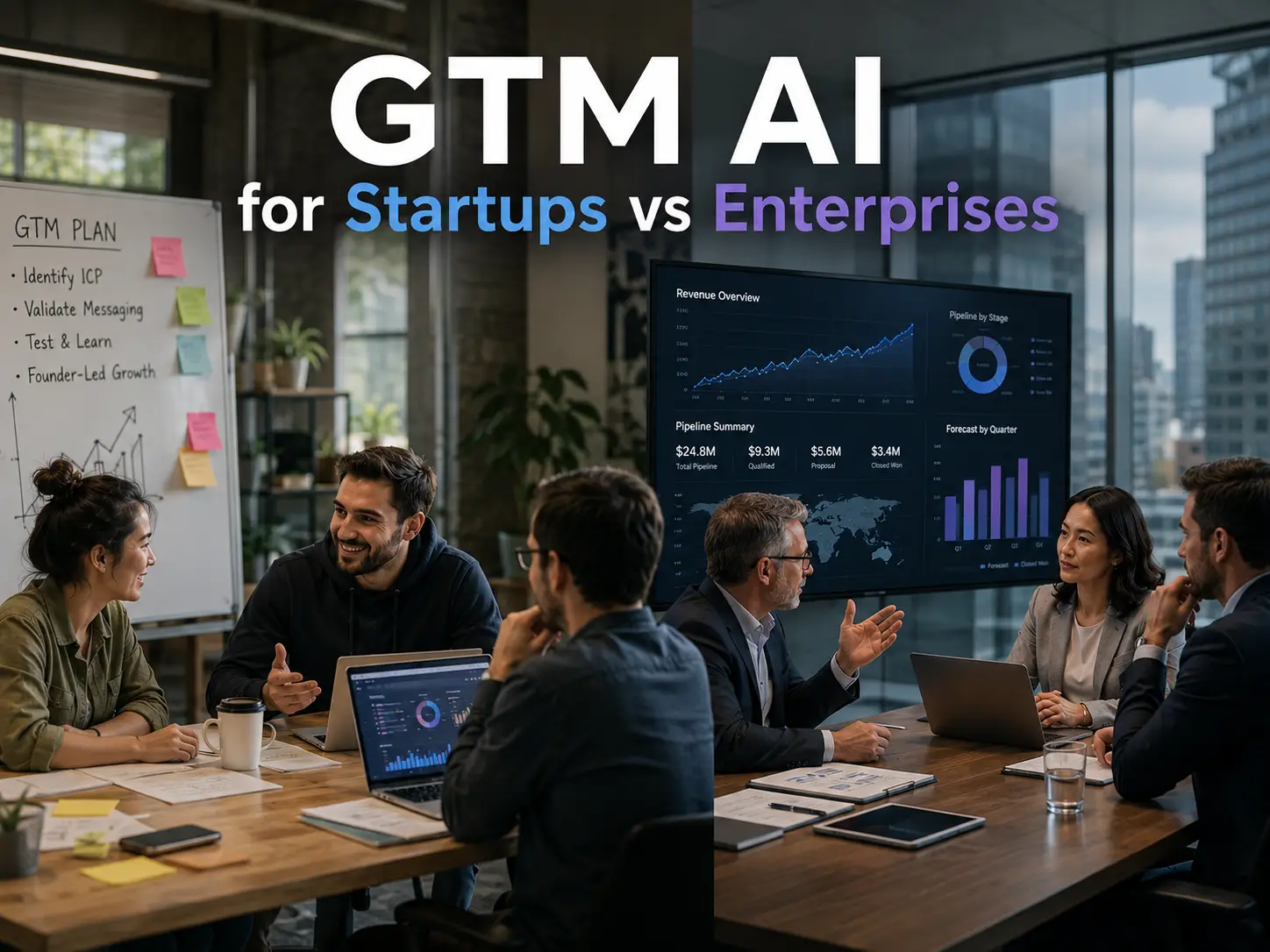
Many teams hear about GTM AI and rush into tools. Startups and enterprises should not build the same system. They have different teams, budgets, data, risks, and sales cycles. GTM AI should match the company stage, not copy what another company is doing.
A startup may need faster account research and better founder-led outreach. An enterprise may need connected workflows across sales, marketing, operations, and customer success. Both can use AI GTM planning, but the setup should not be the same. The real value comes from choosing the right use cases at the right time.
Why Company Stage Changes Everything
Startups work with limited data and smaller teams. Their market may still be changing. Their ideal customer profile may not be final yet. Sales conversations may happen through founders, early reps, or customer-facing leaders. In this stage, GTM AI should support learning and speed.
Enterprises have a very different challenge. They may have years of CRM records, thousands of accounts, multiple regions, and many teams. Their problem is not always a lack of data. The bigger issue is disconnected data across many systems. AI can help only when teams have a shared view of accounts and revenue signals.
For a startup, the question is simple. Which accounts should we chase first with limited time? For an enterprise, the question is broader. Which accounts, teams, and actions deserve attention across the revenue system?
GTM AI For Startups
Startups need a lean AI setup during the early stage. The first priority should be learning from the market. AI can help your team research accounts, draft outreach, summarize calls, and find buying patterns. It should not add a heavy process too early.
A startup can begin with five practical use cases. First, use AI to research target accounts before outreach. Second, build a simple account scoring based on fit. Third, create short email drafts using account triggers. Fourth, summarize sales calls and group buyer objections. Fifth, review lost deals for patterns that can improve targeting.
This setup gives your team more learning per week. Founders can understand which buyers respond better. Sales reps can spend less time on manual research. Marketing can learn which problems deserve more content support.
Startups should avoid complex automation in the beginning. Too many workflows can slow small teams down. A simple spreadsheet, CRM, enrichment tool, and AI assistant may be enough. The main goal is speed with better judgment.
GTM AI For Enterprises
Enterprises need a more connected GTM AI system. Sales, marketing, revenue operations, and customer success may all work from different tools. Each team may have useful data, but the full account picture may be incomplete.
An enterprise should start by connecting core revenue data. CRM records, product usage, marketing engagement, support tickets, renewal data, and sales calls need a shared model. This is where a Context Graph becomes very useful. It links accounts, contacts, activities, signals, and outcomes in one connected view.
With a Context Graph, AI can understand account history with more depth. A large account may show product interest in one region. Another team inside the same company may raise support issues. A senior buyer may visit a pricing page. A past opportunity may mention a competitor. Connected context helps revenue teams decide the next action with less guessing.
Enterprises can use GTM AI for scoring, forecasting, territory planning, account-based marketing, deal risk alerts, renewal risk, and expansion planning. These use cases need better governance than startup use cases. Large companies also need clear ownership for data, access, review, and team training.
Difference In Data Readiness
Startups may not have enough historical data for deep prediction. Their CRM may contain only a few months of account activity. This does not mean GTM AI is useless. It means the model should start with simple rules and human review.
A startup can define fit using early customer interviews, founder notes, website activity, and closed-won deals. The team can update scoring rules every month as more patterns arrive. AI can support research and drafting while the company learns.
Enterprises have more data, but more data can bring more problems. Old records may have missing fields. Teams may use different stage names. Regions may define qualified leads differently. Product usage may not connect with CRM records. Before advanced AI, enterprises must clean and align the base.
Data readiness is not about having a large database. It is about having data that people can trust. GTM AI works better when account records, buyer roles, signals, and outcomes connect in a useful way.
Difference In Sales Motion
Startup sales can change quickly. One month, the company may target founders. Next month, the team may learn that operations leaders buy faster. AI should help the startup test segments without locking the process too early.
For startups, sales motion support can include account research, talk tracks, objection summaries, and follow-up drafts. The team should review every output before using it. Early sales are too sensitive for blind automation.
Enterprise sales are more layered. Deals may involve many buyers, long approval cycles, and several departments. GTM AI should support account planning and deal health checks. It can also help managers see missing stakeholders, weak next steps, and risk inside large opportunities.
The sales process also needs different metrics. Startups should track reply quality, meeting fit, demo conversion, and early win patterns. Enterprises should track account coverage, stage progression, forecast accuracy, renewal risk, and expansion pipeline.
Difference In Marketing Use Cases
Startup marketing should use AI to learn what message earns attention. The team can test landing page ideas, ad angles, content briefs, and email copy. AI can also help turn sales call themes into useful content topics.
The main rule is simple. Startup marketing should stay close to real buyer conversations. AI outputs should be checked against actual sales calls and customer notes. Otherwise, the content may sound broad and miss the market.
Enterprise marketing has a different job. The team may run campaigns across segments, regions, products, and account tiers. AI can help with account segmentation, audience selection, personalization, and campaign routing. A Context Graph can help marketing understand which accounts are researching, comparing, or expanding.
This helps enterprises reduce wasted campaign spend. Marketing can support early-stage accounts with education. Sales-ready accounts can receive more direct outreach. Existing customers can receive messages linked with usage and expansion signs.
Difference In Governance
Startups need basic rules for safe AI use. The team should know which customer data can be entered into tools. Customer contracts, private notes, and financial details need extra care. Even small companies should protect buyer trust from the start.
Enterprise governance needs a deeper system. Large companies may need legal review, security approval, access limits, audit logs, and content review rules. Teams also need guidance on who can approve AI-generated messages and customer-facing material.
An AI GTM plan without governance can cause problems. Bad data can reach customers. Private details can enter unsafe tools. Teams can make decisions based on scores nobody understands. Governance keeps AI useful without hurting trust.
How Startups Should Begin
A startup should begin with one revenue problem. Poor account targeting is a common starting point. The team can build a simple account list, add enrichment, score fit, and test outreach. Each week should produce learning for the next week.
Startups should keep the first system light. Use a CRM, one enrichment source, one AI assistant, and call notes. Build a simple scoring sheet before buying a larger platform. Add more tools only when a manual process starts breaking.
How Enterprises Should Begin
An enterprise should begin with data alignment. The first project should connect account data across key systems. A Context Graph can help teams join signals from sales, marketing, product, and success.
After the base is ready, pick one use case with clear ownership. Deal risk alerts, account scoring, or renewal risk can work well. Measure results before expanding to every region or team.
Final Thoughts
GTM AI is useful for both startups and enterprises, but the starting point is different. Startups need speed, learning, and better account focus. Enterprises need connected data, governance, and team alignment. The right AI GTM plan should match the company's stage.
A startup should not copy an enterprise playbook too early. An enterprise should not run AI through scattered tools without a shared context. Build the system around your current revenue challenge. Then use GTM AI to guide better accounts, better timing, and better revenue decisions.