How Real-Time TTS APIs Improve Hybrid Meeting Accessibility
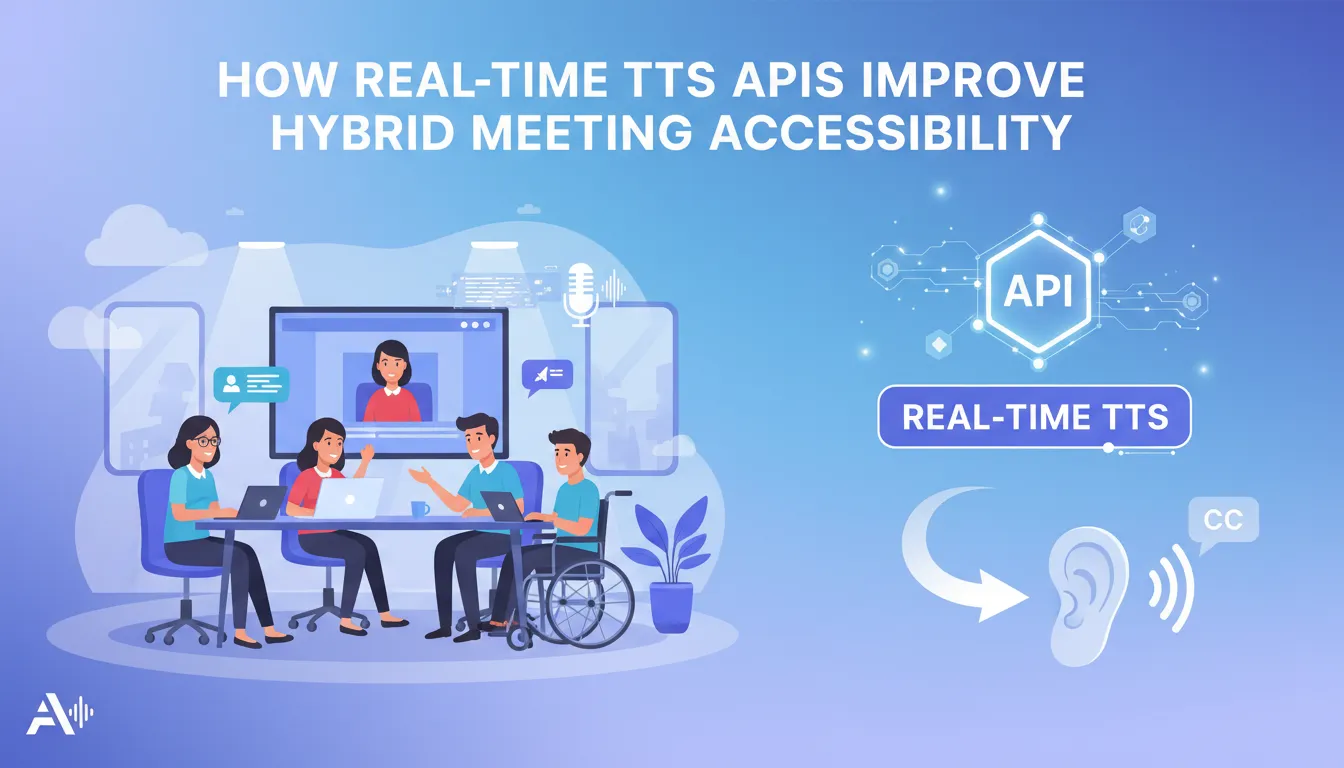
Global teams use hybrid meetings on a daily basis. Everyone wants a smooth and inclusive experience; some join from the office, while others connect remotely. But when participants speak different languages, audio quality deteriorates, accents are strong, communication difficulties frequently arise. This is where real-time TTS APIs come in and help everyone understand meetings.
The rise of accessibility needs in hybrid collaboration
Nowadays, a lot of businesses operate in several different areas. Even small groups may speak various native tongues and operate in different time zones. Hybrid meetings may feel unbalanced in this structure.
As an example, in a busy conference room, a remote user can find it difficult to hear an employee.
Sometimes it's very difficult for someone who doesn't speak the language to follow quick interactions with someone. Clearer voice output may be required for a team member who has hearing challenges.
All of these problems are lessened by real-time text to voice, which transforms text into instantly playable, clear, natural audio. Even in situations where the meeting arrangement is not ideal, it facilitates easy conversation.
What real-time TTS APIs bring to hybrid meetings
Instant, consistent speech output
In a fast discussion, people often interrupt each other to speak quickly. Real-time TTS APIs allow meeting apps, collaboration tools, note-taking platforms to generate speech instantly. When someone types a message in the chat panel, it can be converted into clear voice output without delay.
This creates a more equal experience. Participants who prefer reading can follow chat messages, while those who rely on audio can hear them clearly at the same time.
Better accessibility for diverse teams
Inclusive meetings require more than just good microphones. They need channels that support different communication styles. Real-time TTS adds accessibility for:
- People who read better than they listen by offering synchronized audio playback.
- Participants with mild hearing challenges who need stable and enhanced speech.
- Users who prefer text communication during busy loud meetings.
- Anyone who joins from a device with poor audio hardware.
By offering consistent and natural voice output, teams stay aligned even when the physical setup varies.
Multilingual support for cross-border collaboration
A common pain point in hybrid meetings is the mix of languages. Not everyone is confident speaking English. Real-time multilingual TTS helps reduce language barriers by converting written messages into natural-sounding local languages.
This is where solutions like falcon multilingual text to speech API deliver strong value. When a team member types a message in a shared tool, it can instantly speak that message in a chosen language and help the listener understand the context clearly.
You can integrate Falcon Multilingual text to speech into meeting apps, live chat tools, and internal communication platforms to ensure every participant understands key points without needing separate translation tools.
Consistent clarity even in noisy environments
Conference rooms often experience background noise. Remote participants may join from a busy home environment. In these situations, natural TTS audio helps maintain clarity. Instead of depending on the speaker’s environment, the system produces clean, professional-quality voice output.
This helps remote attendees stay engaged even when real human voices fade in and out because of echo noise.
How TTS APIs support meeting platforms and tools
Meeting platforms can embed real-time TTS in several practical ways.
1. Audio summaries during long calls
Some tools generate real-time meeting notes. By adding TTS, these notes can be read out at key moments. This helps participants catch up quickly if they rejoin after a network drop.
2. Read-aloud chat messages
Chat messages in hybrid meetings often get ignored because speakers don’t notice them while talking. TTS can read these messages aloud so no important input is lost.
3. Voice output for translated subtitles
Many teams use live captioning. When TTS is added, these captions can also be converted into voice output in another language. This helps participants who prefer listening.
4. Accessibility mode for users with hearing challenges
Some participants may rely on both text and audio to understand conversations. TTS helps them follow the meeting more comfortably.
5. Automated announcements during webinars
Webinars often need repeated reminders about timing, Q&A, session changes. Real-time TTS delivers these updates in a natural voice without requiring the host to repeat themselves.
Benefits of using real-time TTS APIs in workplace communication
Here are some practical advantages that teams quickly notice.
- Faster collaboration since typed messages become audible immediately.
- Better clarity when hybrid environments create uneven audio.
- Smooth multilingual communication through instant voice output.
- More accessible meetings for users with diverse needs.
- Lower cognitive load because people can listen and read at the same time.
Why multilingual TTS is becoming a priority
Modern teams want meeting sessions where everyone from interns to executives can fully participate. Multilingual TTS plays a major role by enabling polyglot communication without forcing every speaker to switch languages.
For instance, the API can produce speech output in Spanish for a team member from Latin America, while a manager can make remarks in English. When combined with translation tools inside meeting software, this makes global collaboration far more fluid.
Many developers use the falcon multilingual text to speech API to create this type of multilingual, real-time audio system. It is a sensible option for hybrid meeting solutions since it provides natural voices, quick response times, and multilingual support.
Future of hybrid meeting accessibility with TTS
As companies continue to blend remote and office work, the demand for equal and accessible communication will only grow. Real-time TTS will likely integrate with:
- AI meeting assistants
- Real-time translation engines
- Virtual office tools
- Workflow automation platforms
It will not replace human conversation. Instead, it will enhance clarity, remove noise issues, and support international collaboration.
Conclusion
When all participants feel included and can easily follow the conversation, hybrid meetings function best. By producing clear voice output quickly, real-time TTS APIs assist teams in overcoming noise, accents, and linguistic variances. For international teams, they facilitate easier, more accessible, and more pleasurable collaboration.