Understanding VDR costs: What affects virtual data room pricing
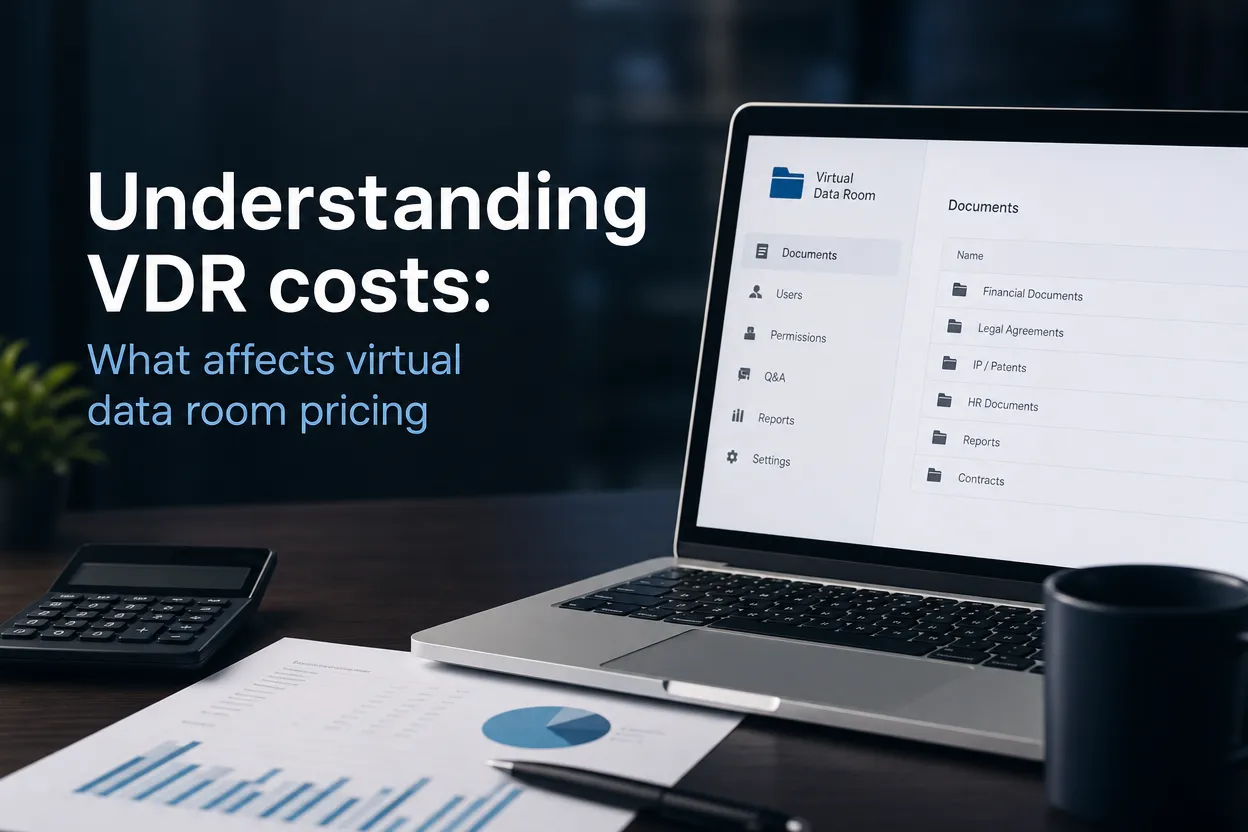
A virtual data room is a secure online platform where businesses collaborate on confidential documents. Companies prefer virtual data rooms over traditional file-sharing platforms, such as Google Drive, when there’s a lot of highly sensitive information involved, such as during mergers and acquisitions, legal reviews, investment rounds, or clinical trials.
With virtual data rooms, businesses can apply sophisticated data controls, for example, access permissions, persistent protection after download, dynamic watermarks, screenshot blocking, and immutable audit logs.
This technology is an “industry standard” in M&A. It’s typically more expensive than traditional cloud storage, and that’s expected. Data rooms significantly reduce the risk of multi-million dollar data breaches. Even so, companies still need to understand how VDR pricing works to manage budgets effectively.
How data room pricing models work
Virtual data room providers may apply these pricing models:
Per-page pricing
Per-page pricing means companies pay for the number of documents uploaded to the platform. Not many providers use this model today because it’s too expensive for the customer, given the volume of data routinely shared in today’s transactions.
Seat-based pricing
Seat-based pricing means companies pay for the number of licensed seats in the organization. External collaborators are typically excluded from the seat count (companies don’t pay for them) or are priced separately.
This model works best for small teams, such as startups running a deal process with multiple bidders whose due diligence teams participate as external collaborators.
Usage-based pricing
Usage-based pricing means companies pay for the total available storage, such as 10GB, 50GB, 500GB, or even several TB (terabytes). In this model, companies can typically invite users unlimitedly. Other limits, such as project count, are usually suspended too.
Flat fee
A flat fee is usually just one fixed cost with everything unlimited — users, projects, and features. Still, in practice, VDRs under this pricing model apply reasonable limitations, upon exceeding which, companies pay overage fees.
What factors influence data room costs
The final data room cost depends on how the platform is used during the transaction, with these factors typically considered:
- Number of licensed users
- Storage capacity
- Planned project duration
- Features selected
- Level of onboarding and customer support
- Additional services provided by the VDR vendor
Longer deal timelines can increase data room usage, so companies should also account for that when budgeting VDR costs. This is a common issue — according to Anthony Luu and coauthors at McKinsey & Company, “Nearly one in six transactions today requires over a year to close (compared with one in 20 in the early 2000s).”
Data room pricing comparison: What to look for?
Imagine three VDR providers: the first charges $1,000 per month; the second charges $25 per user, and the third charges $1,000 per 10GB of storage. As a result, it’s often not feasible to compare the prices side by side. Rather, VDR customers look for individual factors that, when accessed together, provide a full picture:
Functionality
Data room vendors typically offer comparable “classic VDR” functionality, while the real difference comes from implementation and nuances. For example, one provider may offer eight levels of access permissions applied to users, files, folders, and subfolders.
Another provider may offer only four levels of permissions, which can limit how precisely a company can control access to files in its expected scenario.
Oftentimes, a better functional fit justifies a higher subscription price as it reduces transactional friction, allowing deal teams to close the project faster.
Overage policies
VDR vendors may approach overages differently. If overages are prorated, users only pay for the portion of usage that exceeds the plan.
Some vendors apply fixed overages. These are preset fees that can significantly exceed the real portion of extra usage. This is where a seemingly affordable vendor with fixed overages can become (not always but quite often) more expensive than a premium vendor with prorated overages.
Add-on services
Add-ons are another factor that helps to compare VDR prices. Some vendors may offer important capabilities as add-ons rather than including those capabilities in pricing tiers.
Here, VDR users need to be careful. A VDR vendor may appear cheaper initially, yet the total usage cost may increase significantly if add-ons, presented by the vendor as optional, are, in fact, critical to data room workflows.
For this reason, companies should carefully examine which capabilities are provided for an additional fee. If too many tools, or crucial tools, are offered as add-ons, the total cost may become higher than advertised.
Virtual data room cost estimation: How to do it the right way?
VDR vendors often offer pricing proposals based on the provided requirements:
- Expected number of users
- Storage requirements
- Required features
- Deal duration
Vendors can then estimate the cost of platform usage based on these assumptions. These estimates are usually reliable unless the transaction scope expands significantly. Companies that regularly run transactions (PE firms, investment banks, corporate development teams) often share project parameters based on previous deals to get a more accurate quote.
Why do transparent pricing models matter?
The value of transparent data room pricing goes beyond the simple idea that “it’s fair when we know how much we pay and for what exactly.” VDR vendors that share a transparent pricing philosophy tend to make billing clear, simple, and predictable.
Otherwise, deal teams may be forced to become constantly cost-conscious in ways that are counterproductive to actual M&A work:
- Delaying uploads to avoid crossing storage thresholds
- Compressing or converting files to conserve storage
- Rationing platform features before caps are reached
- Postponing certain workflows until the next billing cycle
- Creating workarounds for capabilities locked behind higher pricing tiers and add-ons
Deal teams will worry about none of those issues when a vendor’s billing is structured to stay clear as the project evolves. The transparent pricing approach by Ideals, with one clear cost and predictable overages, is just one example of that model.
Bottom line
The data room cost is shaped by how the deal unfolds and how the vendor treats limits, overages, and add-ons. That’s why the best approach to evaluating the price of a data room is to see how consistent the price remains as diligence expands and the platform is used without hesitation.