Carrier Email to Text Gateways Are Shutting Down: What Your Business Needs to Know
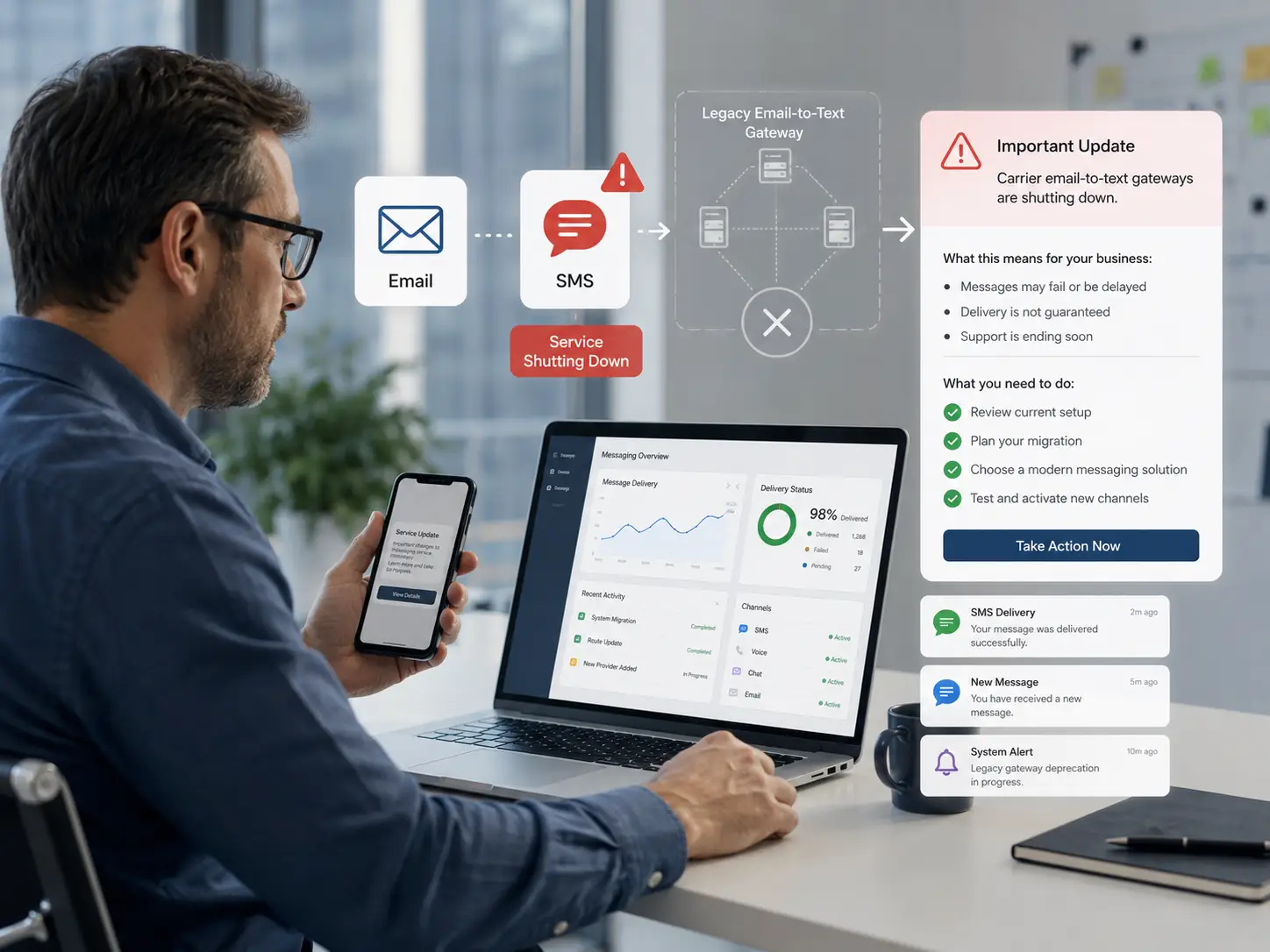
For years, businesses used a simple trick to send text messages without paying for an SMS platform. They would email a special carrier address like 5551234567@txt.att.net, and the recipient would get a standard text message on their phone. No software, no monthly fees, no setup required.
IT teams, medical offices, alarm systems, CRM automations, and thousands of small businesses relied on these free carrier gateways every day. They were invisible infrastructure that just worked. Until they stopped working.
Starting in 2024, all three major US carriers began shutting down or degrading their email to text gateways. AT&T went first. Verizon followed. T-Mobile is next. If your business still depends on these gateways for appointment reminders, alert notifications, or customer texts, this article explains exactly what happened, which gateways still work, and what to use instead.
What are carrier email-to-text gateways?
Every major US carrier used to offer a free email to SMS gateway. You could send an email to a phone number at a carrier-specific domain, and the carrier would deliver it as a text message to that phone.
The gateway addresses looked like this:
AT&T: 5551234567@txt.att.net for SMS or @mms.att.net for MMS
Verizon: 5551234567@vtext.com for SMS or @vzwpix.com for MMS
T-Mobile: 5551234567@tmomail.net
Businesses loved these because they required zero setup. Any system that could send email (a CRM, a server monitoring tool, a scheduling app, even a simple mailto link) could send a text message for free.
The problem was that carriers never designed these gateways for business use. There was no delivery tracking, no opt-out compliance, no sender verification, and no guarantee the message would actually arrive. As carriers tightened spam filtering and shifted to 10DLC registered business messaging, these free gateways became collateral damage.
AT&T: Gateway Shut Down in June 2025
AT&T was the first major carrier to pull the plug. In June 2025, AT&T officially discontinued its @txt.att.net and @mms.att.net email-to-SMS gateways. There was no gradual phase-out. The service simply went dark.
What Happened
Emails sent to @txt.att.net stopped delivering entirely. There was no advance warning to businesses. Thousands of automated systems, including CRMs, server monitoring tools, and appointment schedulers that emailed @txt.att.net, broke overnight. Universities like Princeton and Stanford had to send emergency IT notices to staff and students explaining the disruption.
Who Was Affected
The impact was widespread. Medical offices using email-based appointment reminders lost their texting capability. IT teams with server monitoring alerts routed through @txt.att.net stopped receiving critical notifications. Alarm companies with panels from ADT, Honeywell, and similar providers that were configured to email alerts as texts went silent. Small businesses that had used this method for years without even knowing it was a carrier gateway suddenly had no way to text customers.
What to Use Instead
Businesses that relied on AT&T's gateway need an AT&T email-to-text alternatives that preserves the same email-based workflow. The idea is simple: you still send from your inbox, and the recipient still gets a text, but the message now routes through 10DLC-compliant numbers instead of the dead carrier gateway. The setup takes under 30 minutes, and the day-to-day workflow feels identical to what broke.
Verizon: VText Degrading Now, Full Shutdown Expected by 2027
Verizon's @vtext.com gateway has not been officially discontinued yet, but it has been functionally broken since late 2024.
What Is Happening
Messages sent to @vtext.com are increasingly filtered, delayed, or silently dropped. There is no error message. The email appears to send successfully, but the text never arrives on the recipient's phone. Verizon has confirmed the service will be fully retired by March 2027. The @vzwpix.com MMS gateway is experiencing the same degradation.
The Silent Failure Problem
Unlike AT&T's clean shutdown, Verizon's degradation is actually worse for businesses because there is no obvious error. A medical office sending appointment reminders via @vtext.com might not realize texts are not arriving until patients start missing appointments. The system looks like it is working when it is not. This silent failure makes it harder to diagnose and more damaging over time.
Who Is Affected
Any business or automation that sends to @vtext.com addresses is affected. This includes monitoring and alerting systems like Nagios, Zabbix, and Datadog that were configured with Verizon gateway addresses. It also includes CRM workflows that include Verizon customer numbers in text-to-email automations.
What to Use Instead
The most straightforward migration is a Verizon VText alternative that routes texts through registered business numbers. The key requirement is that the replacement must support the same email-based sending workflow, so existing automations only need a recipient address change, not a full system rebuild.
T-Mobile: tmomail.net Increasingly Unreliable
T-Mobile's @tmomail.net gateway is still technically active, but reliability has dropped sharply since mid-2025.
What Is Happening
Aggressive spam filtering now blocks many legitimate business messages. Delivery rates have fallen from near 100% to under 50% for some senders. There is no official shutdown date announced yet, but the trajectory matches exactly what happened with AT&T and Verizon. The T-Mobile and Sprint merger also created additional routing complexity that has made the situation worse.
The Pattern Is Clear
All three major carriers are moving away from free email to SMS gateways. The reason comes down to one thing: 10DLC. This is the carrier mandated registration system for business messaging. Registered, verified senders get reliable delivery. Unregistered email-to-text gateways get filtered or blocked. The free ride is over.
Who Is Affected
Businesses that used @tmomail.net as a fallback after AT&T shut down are now losing that backup too. Multi-carrier automations that send to all three gateway domains are seeing partial failures. Sprint legacy customers whose @messaging.sprintpcs.com addresses stopped working are in the same situation.
What to Use Instead
Businesses still using @tmomail.net should migrate now rather than waiting for an official shutdown date. A T-Mobile email-to-text alternative that uses 10DLC-compliant routing ensures messages actually arrive, with delivery confirmation that the old carrier gateway never offered.
Why This Is Happening: 10DLC and Carrier Compliance
The carrier gateway shutdowns are not random events. They are part of a broader industry shift toward 10DLC (10-digit long code) registration for all business SMS in the United States.
What 10DLC Requires
Every business that sends text messages now needs three things. First, business identity verification, which means registering your EIN, business name, and address with the Campaign Registry. Second, campaign registration, which means describing what messages you send and why. Third, carrier approval before you are allowed to send a single text.
Why Carriers Are Enforcing It
There are three driving forces. Spam reduction is the biggest one, since unregistered gateways were heavily exploited by spammers and scammers. Revenue plays a role too, because carriers can now charge registration and per message fees for verified senders. And compliance matters, since TCPA and CTIA guidelines increasingly require sender verification for consumer protection.
What This Means for Your Business
The free, anonymous email-to-text era is over. Every business that sends SMS now needs to be registered and verified. The good news is that 10DLC registration typically takes one to two weeks, and once approved, delivery rates improve dramatically. Most registered senders see 95 to 99% delivery rates, compared to the 50% or less that the degrading carrier gateways now deliver.
How to Migrate Without Changing Your Workflow
The biggest concern businesses have about migrating off carrier gateways is workflow disruption. If your CRM, monitoring tool, or scheduling system is configured to email @txt.att.net or @vtext.com, rebuilding that entire automation sounds expensive and time-consuming.
The good news is that it does not have to be that complicated.
How Email-to-SMS Services Work
Modern email-to-SMS services preserve the exact same workflow your business already knows. Here is the process:
First, you sign up and complete 10DLC business verification. This takes about one to two weeks for carrier approval. Second, you receive a registered business phone number. Third, you replace the old carrier gateway address in your systems with the new service address. Everything else stays exactly the same.
Your system still sends an email. The recipient still gets a text. But now the message routes through a verified, 10DLC-compliant number with actual delivery tracking. Instead of emailing 5551234567@txt.att.net (which is dead), you email the same number at the new service domain. Your CRM, monitoring tool, or scheduling system does not know the difference.
For most businesses, the migration takes under 30 minutes per system. The only change is the recipient address in your email automation. No new software to install. No new dashboard to learn. No retraining your team.
The Bottom Line
Carrier email to text gateways served businesses well for over a decade. They were free, simple, and invisible. But AT&T's shutdown, Verizon's degradation, and T-Mobile's filtering have made them unreliable at best and completely broken at worst.
The replacement is not complicated. Email to SMS services that use 10DLC-compliant routing offer the same workflow (send from email, recipient gets a text) with better delivery, actual tracking, and carrier approval that the old gateways never had.
If your business still emails @txt.att.net, @vtext.com, or @tmomail.net, the migration is straightforward and takes less than an hour. The only real risk is waiting until the gateway you depend on goes fully dark and your customers, patients, or monitoring alerts stop arriving without warning.