
How to Scope a VoIP Software Project: From Requirements to First Working Call
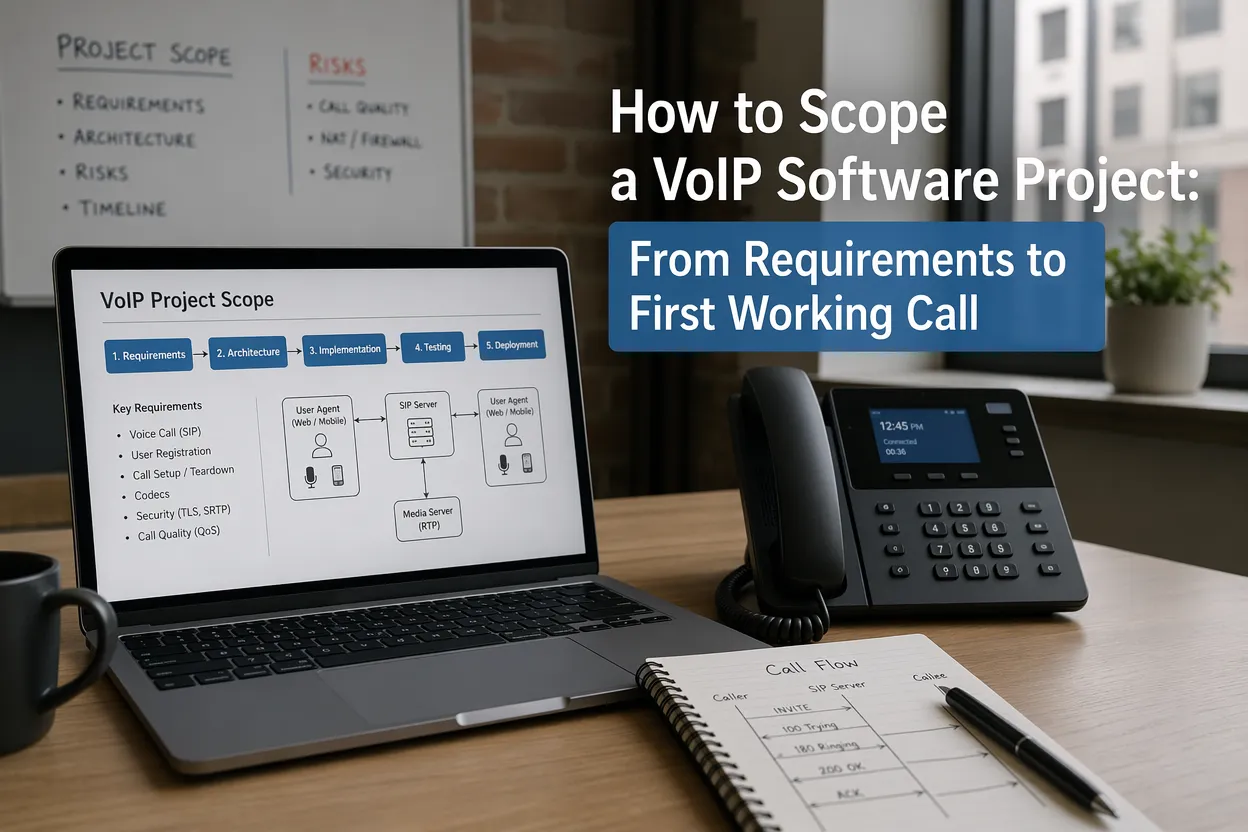
Most VoIP projects don’t fail because of code. They fail because no one agrees on what a “working call” actually means.
A call is not a button in an interface. It’s a chain of events across networks, protocols, and systems that have to behave predictably under pressure. If that chain isn’t clearly defined at the start, teams end up debugging assumptions instead of software.
That’s why project scoping matters more here than in typical web development. Voice systems are less forgiving. You don’t get partial success. Either the call connects and sounds right, or it doesn’t.
Start with how calls behave, not what the UI shows
Feature lists are easy to write and mostly useless. “Call recording,” “conference calls,” “IVR” don’t tell engineers what the system actually needs to do.
Real VoIP project requirements describe behavior in context. A support agent answers a call that has already waited in a queue. A sales rep calls a lead, and the system logs the interaction in HubSpot or Salesforce. A customer calls a number, hears a menu, presses a key, and gets routed based on time of day.
That level of detail matters. Without it, two engineers can build two completely different systems, and both think they’re correct.
It also exposes edge cases early. What happens if no agents are available? What if the call drops mid-transfer? What if the CRM API is slow? These aren’t corner scenarios, they’re daily occurrences in production.
The discovery phase is where projects either stabilize or drift
This part is often rushed. It shouldn’t be.
A proper discovery phase forces decisions that teams tend to postpone: what you’re building in-house versus what you rely on externally, how calls flow through the system, and where data lives. It’s also where constraints surface: regulatory requirements, expected call volume, and geographic distribution.
Take concurrency. A small internal tool might handle 10–20 simultaneous calls. A customer-facing platform can hit thousands. That difference alone changes everything: infrastructure, routing logic, monitoring, and cost.
Or take geography. If your users are split between Europe and the Middle East, routing all media through a single region will introduce noticeable delay. Fixing that later means redesigning core parts of the system.
Skipping this step doesn’t save time. It moves the work into later stages where changes are harder and more expensive.
VoIP architecture is shaped by physics, not preferences
You can’t design voice systems the same way you design CRUD apps.
Voice traffic is real-time. It doesn’t wait for retries or tolerate long processing chains. A few hundred milliseconds of delay is enough to make conversations awkward. Packet loss translates directly into missing audio.
That’s why VoIP architecture separates responsibilities. Signaling handles session control: who is calling, and where the call should go. Media handles the audio stream itself.
In practice, this leads to a familiar structure: client applications or devices, signaling servers, media servers, and gateways to external networks. Tools like Asterisk, FreeSWITCH, or Kamailio often sit at the core of these systems, depending on scale and flexibility requirements.
There’s no single “correct” setup, but there are clear tradeoffs. A single-node deployment is simple and cheap, but it becomes a bottleneck quickly. A distributed system scales better but adds operational complexity, including load balancing, synchronization, as well as failover.
These VoIP architecture decisions shape everything that follows — teams that ignore the tradeoffs usually end up rewriting large parts of the system within a year.
SIP is not a feature, it’s the backbone of call control
The SIP protocol shows up early in any VoIP discussion, but it’s often misunderstood.
SIP doesn’t carry audio. It manages sessions. It tells the system how to establish, modify, and terminate calls. That includes registration, call routing, transfers, and presence.
Why does this matter during project scoping? Because many “features” are just variations of SIP behavior.
Call forwarding, for example, is not a separate module, it’s signaling logic. Same with call transfer or multi-device ringing. If you treat these as isolated features, you’ll misjudge both effort and complexity.
SIP also introduces constraints. NAT traversal, authentication methods, and carrier compatibility affect implementation. Providers like Twilio, Vonage, or local SIP trunk vendors often have specific requirements that shape how your system needs to behave.
You don’t need to master every detail upfront, but you do need to account for the protocol’s role in the system. Ignoring it leads to brittle designs.
Define the first working call early and mean it
At some point, the system has to do one simple thing: connect two endpoints and transmit audio both ways.
That’s the first real milestone.
A “working call” means more than a successful connection. It means devices can register, signaling completes without errors, codecs are negotiated correctly, and audio flows with acceptable quality.
Getting there requires a minimum viable setup: a signaling server, a media path, and at least two endpoints. That could be softphones like Zoiper or Linphone, or custom apps.
This milestone forces clarity. It strips the system down to essentials and exposes integration gaps early. If you can’t establish a stable call at this stage, adding features won’t help.
Teams that delay this milestone often spend weeks building surrounding functionality without proving the core works.
Integration is where timelines usually break
On paper, connecting to external systems looks straightforward. In practice, it rarely is.
Telecom carriers have their own requirements like authentication methods, supported codecs, as well as routing rules. Even established providers like Twilio simplify some aspects but introduce others, especially when you move beyond basic use cases.
Then there are internal systems. CRM integrations, analytics pipelines, and billing platforms. Each comes with its own latency, failure modes, and data formats.
A common mistake is treating integration as a later phase. By the time teams get there, architectural decisions are already locked in, and mismatches become hard to resolve.
Integration should be part of project scoping from day one. Not in full detail, but enough to understand constraints and dependencies.
Non-functional requirements decide whether the system survives production
It’s easy to build something that works in a controlled environment. It’s much harder to keep it working under real conditions.
Voice systems are sensitive to network quality. Latency, jitter, and packet loss all affect call experience. Unlike web apps, you can’t mask these issues with retries or caching.
Security adds another layer. Encrypting signaling and media, using TLS and SRTP. is standard practice, not an enhancement. At the same time, encryption introduces overhead, which affects performance.
Scalability is another pressure point. Handling a spike from 50 to 500 concurrent calls is not a linear problem. It affects CPU usage, network bandwidth, and session management.
These factors don’t show up in feature lists, but they define whether the system is usable.
Where project scoping usually goes wrong
Patterns repeat across teams.
Requirements stay vague because stakeholders assume details can be figured out later. The discovery phase gets compressed to hit deadlines. Architecture decisions are made based on familiarity rather than fit.
Then reality catches up. Calls fail under load. Audio quality drops. Integrations behave unpredictably.
Fixing these issues is possible, but it’s expensive. Not just in engineering time, but in lost trust both inside the team and with users.
From scope to something that actually works
A well-scoped VoIP project doesn’t guarantee success, but it removes a large class of avoidable problems.
It aligns expectations. It defines what a call is supposed to do. It sets boundaries for the system and exposes constraints early.
From there, the path becomes clearer. The discovery phase informs the architecture. The architecture supports the first working call. And once that call is stable, everything else, recording, analytics, automation, has something solid to build on.
Without that foundation, every new feature adds instability.
With it, the system behaves the way users expect: you click “call,” and it just works.