How Remote Managers Use AI Video to Onboard New Hires Faster
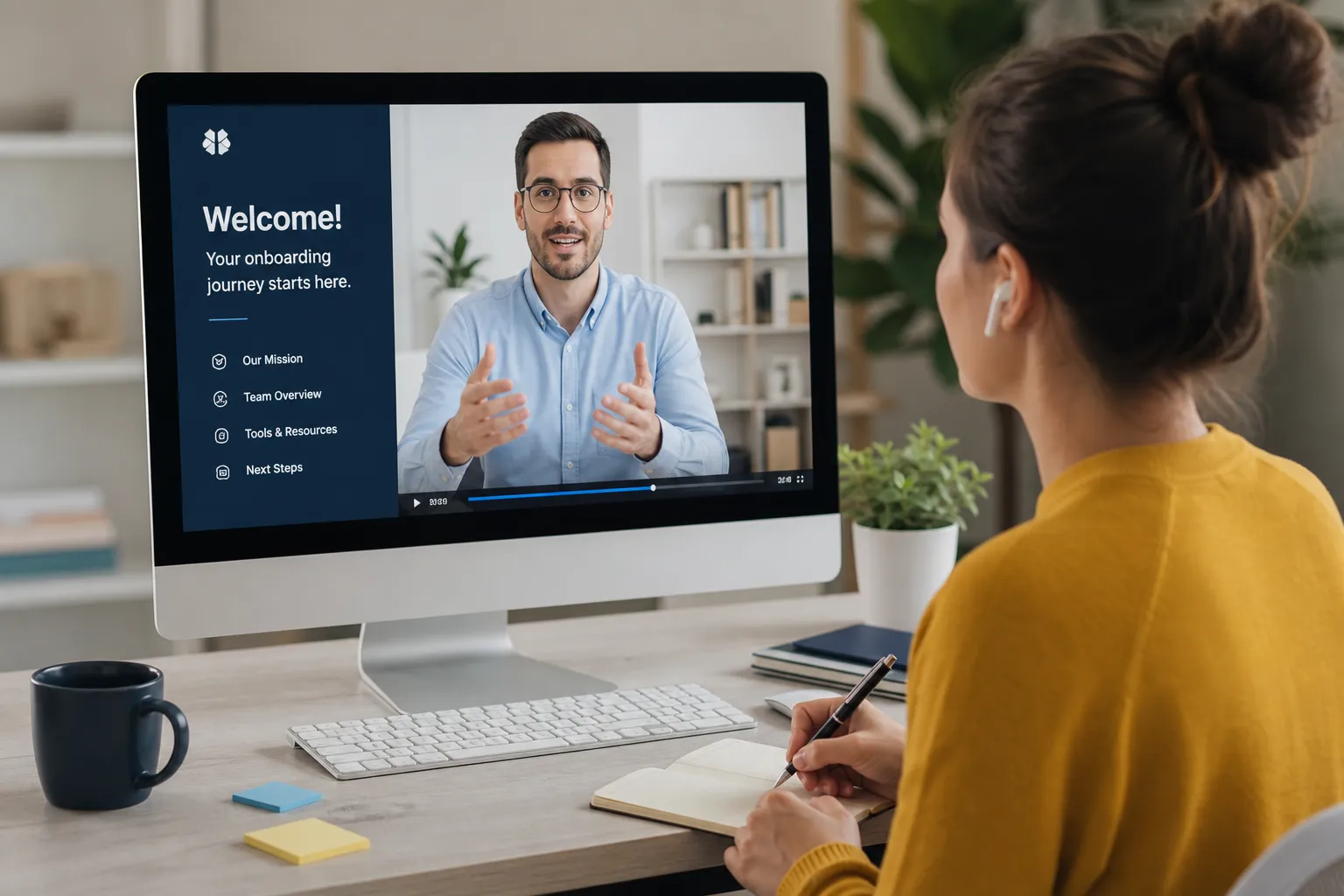
Remote managers, by getting AI video tools to churn out role-specific welcome videos, walk-through tutorials, and async training content that previously relied on planned live sessions or costly productions are drastically reducing onboarding time from weeks to days. Rather than conducting the same kickoff call eight times a quarter or throwing new hires a maze of written materials, managers create personalized, narrated videos in a few minutes, and new employees can watch them whenever they want. This change is Mainly significant for distributed teams working across different time zones, as live onboarding was always the weakest link.
The point of the change is not to do away with human contact but rather to move humans to the places where they really make a difference. The first thing that a manager and a new employee talk about should be spending toward answering questions and getting to know each other rather than a narrated org chart or explaining how to submit a timesheet. AI video takes care of the repeatable parts so that the hands-on time can focus on things that are not.
What AI Video Tools Actually Do in an Onboarding Context
Today's AI video platforms enable managers to simply type or paste the script, select a presenter (either a generic AI avatar or their own cloned version), and generate a complete video with voiceover, captions, and basic visuals in less than five minutes. Some are able to fetch content directly from a URL or document, so a manager can insert a Notion page about company values and receive a four-minute narrated summary without any original writing. Captions, multi-language voiceovers, and different aspect ratios for mobile are most often included in the paid packages.
When it comes to employee onboarding, the cases that have really proven their value are manager welcome videos, role-specific tool demonstrations (our Linear usage, running the weekly standup, accessing the shared drive), policy breakdowns that turn a PDF wall into something digestible, and asynchronous introductions to cross-functional partners that a new hire will collaborate with. The cost of producing videos per unit decreases dramatically - from approximately $300 to $500 when working with a freelance editor or using several hours of internal time - to a mere $5 to $15 in tool credits and a manager's 20 minutes.
Why It Compresses the Onboarding Timeline
Usually remote onboarding wastes a great deal of a new hire's first week just arranging meetings. For example, a new employee in Lisbon might wait for a kickoff call with their manager in Austin, after which they'd have to wait for two days more to get an intro from the product lead in Singapore, and a day more for a walkthrough of the tools by someone from London. Each handing over consumes calendar time. Remote onboarding surveys in the industry keep time-to-productivity for knowledge workers at a level from 60 to 90 days, with the initial two weeks making up a large part of the friction.
When the necessary content is pre-recorded and put in a well organized playlist, a new employee can be introduced to the material on their first day, regardless of Truth is their manager might be in a time zone that's opposite to where they're waking up. A few managers in distributed companies with whom I have had a chance to communicate say that they have reduced the structured part of onboarding from two weeks to four or five working days by having live calls only for questions and judgement-based topics. A new hire still gets human time. They just get it after they've done their homework, which makes the live time roughly twice as useful per minute.
Which Parts of Onboarding Translate Well to AI Video and Which Don't
Process and tooling text translates almost perfectly. A two-minute video demonstrating how the company uses GitHub issues, narrated with the cloned voice of the engineering manager and with screen-record overlays, surpasses a written guide on nearly all measurable dimensions: completion rate retention time to first independent task, etc. Policy content (PTO, expense submission, security basics) is the same kind of content. Repetitive, low emotional stakes, evergreen.
AI video fails at most things that are dependent on the very particular human in front of the camera. Culture talks, team backstory, the manager's personal philosophy on how feedback works on this team. These fall flatter when Clearly the avatar has been synthesised, even if it has a cloned voice. Most remote managers who have a lot of experience that I know of divide it clearly: AI for the operational layer, real recorded video (often one-shot on a phone) for the relational layer. New hires can usually tell within five seconds which is which and they turn out to be more forgiving than you would expect as long as you are not pretending.
The Tooling and Setup Decisions That Matter Most
With just a few people working remotely, a compact team can create a functioning onboarding video library for a monthly fee in the range of $30 to $100 a month per seat, based on volume. Deciding between these platforms is Mainly about whether you require your avatar to be almost indistinguishable from a real video, need support for multiple languages for international hires, or want the system to integrate with the locations where your content is stored. Teams that recruit in Europe and LATAM rely mostly on platforms that offer strong voice cloning in 30-plus languages, as translated text on screen is a very different experience from video which seems as if it was made for the viewer.
There's also a practical overlap with marketing functions worth noting. Teams that already use automated solutions for marketing videos to produce ad creative or product explainers often find the same workflows transfer cleanly to internal onboarding content, which means one tool subscription can cover both jobs and one person on the team usually owns both libraries. That consolidation matters for smaller companies where nobody is going to manage three separate video tools.
Regardless of the platform you choose, the real groundwork that decides if the system is effective or not lies in the structure. A definite playlist or learning path is essential (week one, week two, role-specific deep dives), plus a spot where new hires can ask questions directly on the videos (Loom-style comments, a Slack channel, async docs), and finally, one single person who takes charge of content updates quarterly. Without the third factor, the library is bound to get outdated. After half a year, most of the videos talk about the tools that the company has already stopped using, and the new hires start to doubt the whole system.
How This Looks Different Across Company Sizes and Industries
Startups in an early stage with a team size between ten and thirty people can experience greatest immediate benefits, because their main alternative is typically a founder repeating the same story through Zoom or no onboarding at all. A founder may produce a 15-minute company-story video once, update it every six months, and stop spending three hours per new hire on the same talk. Series B and later companies utilize it differently, more for scaling consistency across a growing manager bench so that every new engineering hire gets the same baseline experience regardless of who they report to.
Industries subject to strict regulation like finance and healthcare, which are generally burdened with compliance, rely heavily on AI video for the policy and training layer precisely because the content has to be uniform, auditable, and easily updated when rules change. At the other extreme, agencies and design-led companies generally use it less, they tend to rely on real recorded video for anything client-facing or culture-shaping and they use AI generation mostly for purely operational content.