Top 9 Cloud Contact Center Providers in 2026

Running a contact center used to mean picking one platform and living with it. Not anymore. Most teams now juggle an average of 3.9 different contact center technologies at once, according to Puzzel’s State of Contact Centres report cited by TechTarget, and only 3% run on a single unified platform. Add in a cloud contact center software market that’s already worth $22.88 billion in 2026 and heading toward $40.59 billion by 2030 (ResearchAndMarkets), and you’ve got a buying decision that’s gotten a lot more crowded than it needs to be.
Every vendor on the market claims to be “AI-powered” right now. Some of that is real. A lot of it is marketing copy stapled onto a routing engine that hasn’t changed much in five years. Sorting out which is which takes time most operations teams don’t have.
This list covers nine options worth your attention in 2026: one advisory service that helps you skip the guesswork, and eight direct platforms spanning enterprise, mid-market, and small-business budgets. Whether you’re replacing a legacy system or building a contact center from scratch, this should give you a realistic starting point.
What to look for when choosing a cloud contact center provider

A few things matter more than a flashy demo. Here’s what actually separates a good fit from a bad one:
Omnichannel routing - can the platform actually unify voice, chat, email, and SMS into one queue, or does it just claim to?
AI maturity versus AI marketing - ask for a live demo of the automation, not a slide deck. 88% of contact centers report using some form of AI, but only 25% have it fully integrated into daily operations, per data cited in CMSWire. That gap matters.
Compliance coverage - depending on your industry, you’ll need HIPAA, PCI DSS, or FedRAMP support, plus adherence to telemarketing rules. Any provider handling outbound calls should be able to speak fluently about the Telemarketing Sales Rule that the Federal Trade Commission enforces.
Pricing model - per-agent flat fees work for predictable headcount; usage-based pricing can save money for variable call volumes but requires more forecasting discipline.
Integration ecosystem and deployment speed - how well does it plug into your CRM, and how long until agents are actually taking calls on it?
Keep these in mind as you work through the list below. If you’re also comparing this against a broader unified communications setup, it’s worth reading up on comparing UCaaS providers before you commit, since contact center and UCaaS decisions often get bundled together.
1. CommQuotes
CommQuotes isn’t a contact center platform itself, and that’s exactly the point. It’s a vendor-agnostic advisory service that connects businesses to a wide bench of vetted suppliers spanning CCaaS, UCaaS, VoIP, and managed communications services. Instead of sitting through nine separate vendor demos and trying to reverse-engineer which sales pitch is telling the truth, CommQuotes matches you based on your team size, budget, and compliance requirements.
The service costs nothing to use. CommQuotes earns its revenue from provider commissions rather than client fees, and it sticks around after the sale with what it calls “lifetime advocacy” support if you run into issues with whichever provider you end up choosing. That’s a meaningfully different value proposition than the eight platforms listed below it. This is why so many businesses turn to CommQuotes to find the best cloud contact center providers for their specific situation rather than guessing based on marketing pages alone.
If you’d rather start with independent guidance before wading into vendor comparisons, this is the sensible first stop. Best for: businesses that want expert-vetted recommendations instead of self-navigating a stack of demos and sales calls.
2. NICE CXone
NICE has been named a Leader in the 2025 Gartner Magic Quadrant for CCaaS, and its CXone Mpower platform backs that up with genuinely deep functionality. The Enlighten AI suite covers agent assist, quality management, and workforce management in one system, plus autonomous AI agents that can handle full interactions without a human in the loop.
Pricing is enterprise-tier and custom-quoted, which puts it out of reach for smaller teams. Best for: large enterprises that want the deepest AI capabilities and the validation that comes with an analyst-recognized platform.
3. Genesys Cloud CX
Genesys built Cloud CX as a cloud-native, composable platform from the ground up, with predictive routing, journey analytics, and a deep bench of prebuilt integrations. Compliance coverage is broad, including SOC 2, HIPAA, PCI DSS, GDPR, and select FedRAMP authorizations, which matters if you’re in healthcare or finance and need to satisfy an auditor as much as your customers.
Entry pricing sits on the higher end of the market and scales with the CX1 tier you choose. Best for: enterprises running large, complex agent teams of 500 or more that need serious configurability. Providers handling outbound campaigns at this scale should also have their compliance story straight when it comes to the FTC’s Telemarketing Sales Rule, since penalties for violations aren’t small.
4. Five9
Five9 has held onto its spot in Gartner’s Leader quadrant for years running, and its strength shows most clearly in outbound and predictive dialing. It also co-sells tightly with Salesforce Service Cloud, which makes it a natural fit for sales-heavy organizations already living inside that ecosystem.
Five9 Core pricing sits toward the top of this list, reflecting its enterprise-outbound focus. Best for: outbound-heavy sales teams and Salesforce-centric organizations. Given the outbound focus, it’s worth reviewing the FCC’s guidance on telemarketing and robocalls before scaling a dialing campaign on any platform, Five9 included.
5. Talkdesk
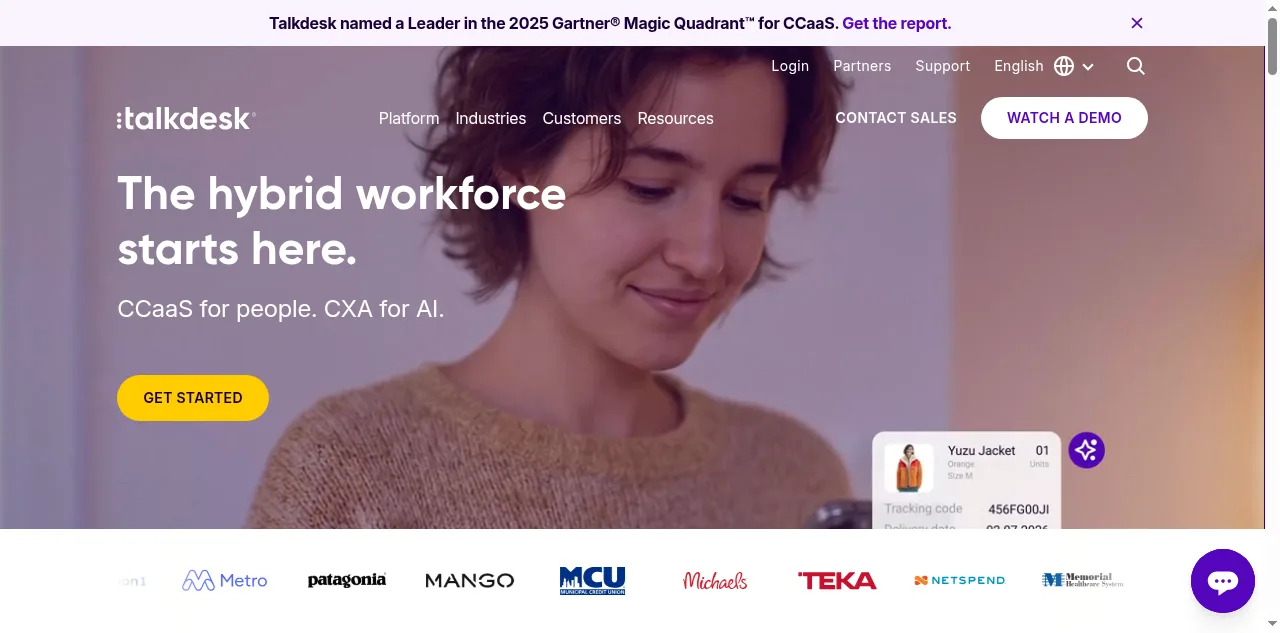
Talkdesk returned to Gartner’s Leader quadrant in 2025 after a two-year absence, and its differentiator is industry-specific “Experience Clouds” for retail, healthcare, and finance, each with prebuilt compliance workflows baked in. Deployment tends to run fast compared to enterprise rivals, and its Salesforce CTI integration is well regarded.
One honest caveat: Talkdesk has been through some recent ownership and financial changes, so vendor stability is worth a real conversation during your evaluation, not just a line item you skip past. Best for: buyers in a specific vertical who want prebuilt compliance templates rather than building from scratch.
6. RingCentral (RingCX)
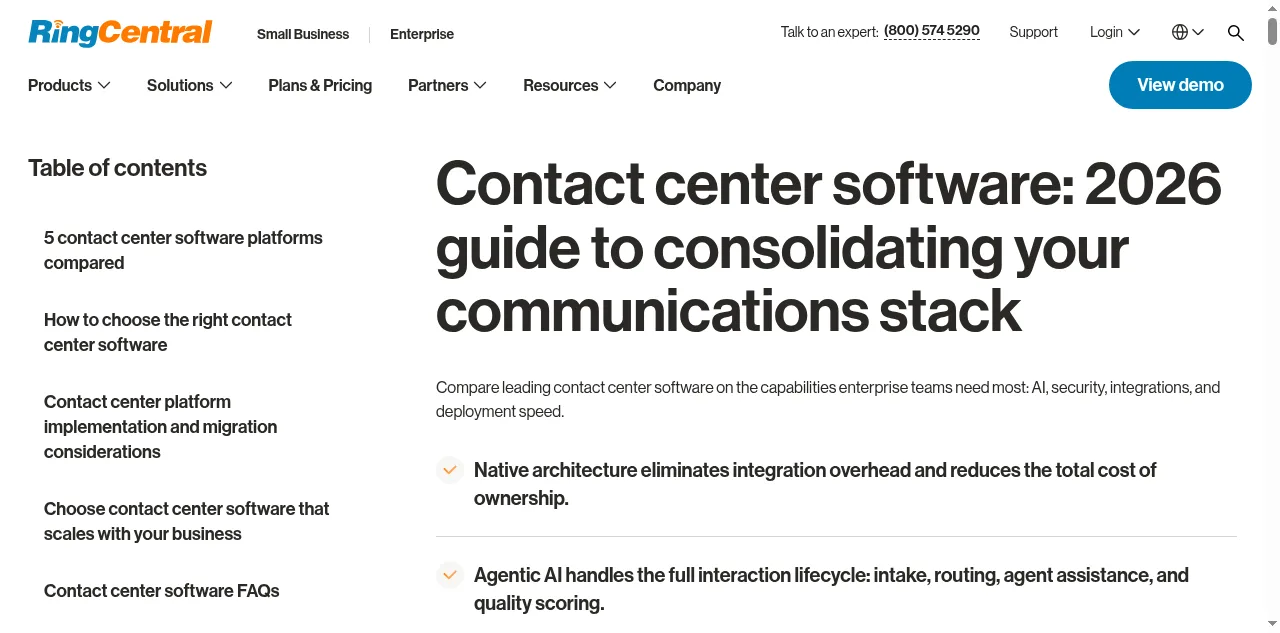
RingCentral bundles UCaaS and CCaaS onto a single bill through RingCX, which simplifies vendor management if you want your phone system and contact center under one roof. Its Enlighten AI engine handles routing across a broad spread of digital and voice channels, and healthcare-specific integrations with Epic and Cerner are a nice touch for that vertical.
Entry-tier pricing lands toward the affordable end of this list. Best for: teams that want their phone system and contact center bundled under a single vendor and a single invoice. If phone number provisioning is part of your decision, our guide on choosing the right business phone numbers covers what to check before signing.
7. Amazon Connect (AWS)
Amazon Connect earned a Leader spot in the 2025 Gartner Magic Quadrant, and it tends to score highest among analysts for AI architecture and generative AI support, largely because it’s built directly on AWS infrastructure rather than layered on top of it. Pricing is consumption-based rather than flat per-agent fees, which can be considerably more cost-efficient for teams with variable call volumes.
The tradeoff is that getting the most out of it usually requires engineering resources comfortable working inside the AWS ecosystem. Best for: technical teams already running on AWS who want granular, code-level customization rather than a pre-packaged interface.
8. CloudTalk
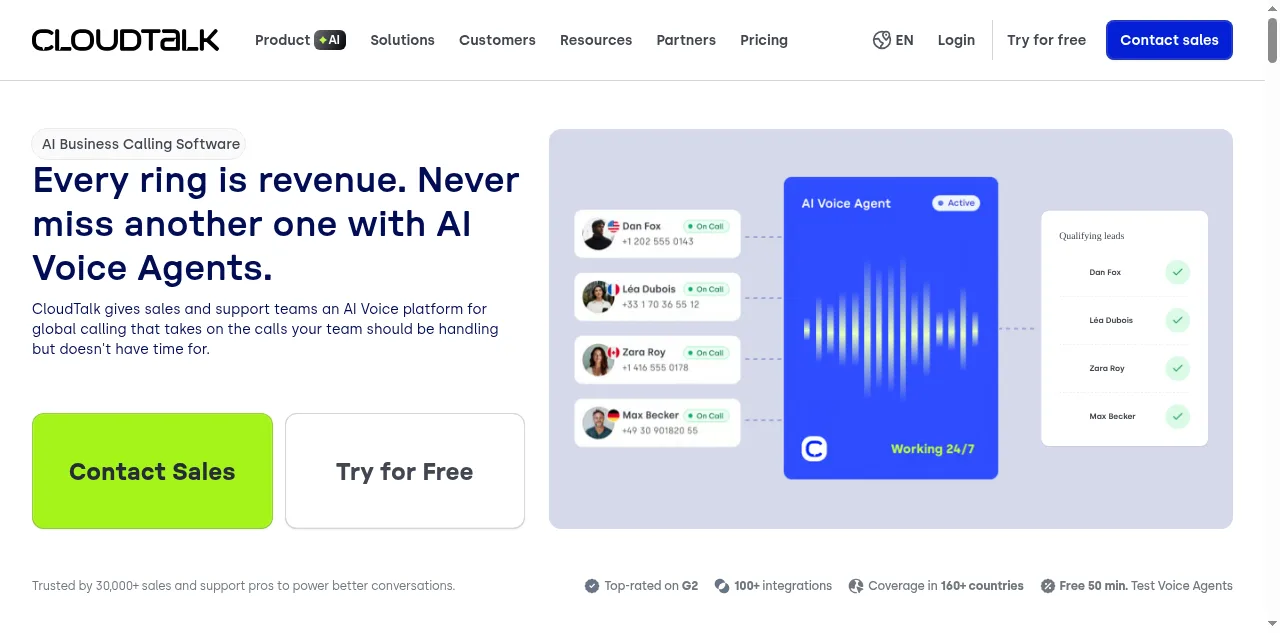
CloudTalk has built a strong following among mid-market and SMB teams, largely on the strength of international phone number coverage spanning dozens of countries and a fast-growing AI feature set that includes real-time transcription, sentiment tagging, and automated call summaries. Deployment is quick, and pricing stays predictable as teams scale.
Best for: small and mid-sized businesses with international customers who need solid coverage without wading into enterprise-level complexity.
9. Nextiva
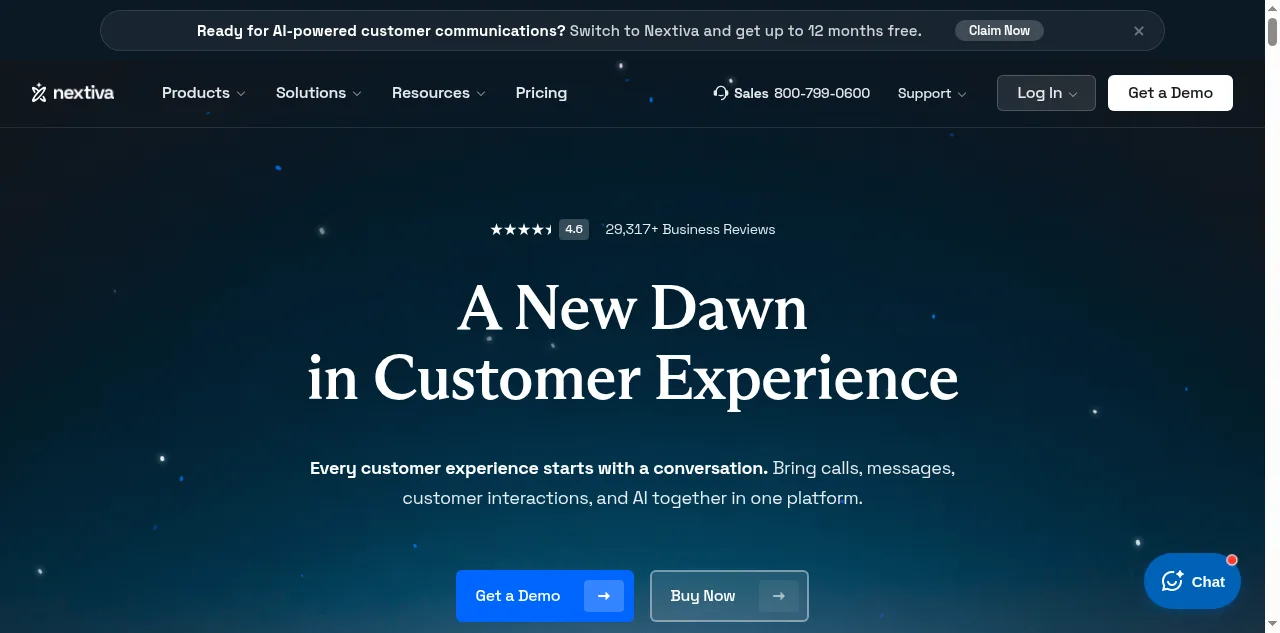
Nextiva shows up near the top of most independent SMB roundups, and it earns that spot by bundling unified communications and contact center functionality into one straightforward suite. It’s not the platform with the deepest feature set on this list, but it doesn’t need to be. Simplicity and a strong customer support reputation are the selling points here.
Best for: small businesses that want an all-in-one, low-complexity communications platform rather than a dozen point solutions stitched together. If you’re weighing build-your-own options against ready-made suites like this one, our roundup on evaluating VoIP development partners is a useful next read.
Choosing the right fit

None of these nine options is wrong, exactly. They’re built for different situations. NICE and Genesys make sense for large, complex enterprise deployments. Five9 and Talkdesk fit teams with specific outbound or vertical-compliance needs. Amazon Connect rewards technical teams already on AWS. RingCentral, CloudTalk, and Nextiva serve small and mid-sized budgets well, each with its own tradeoffs on price and simplicity.
The market’s continued growth, with large enterprises still holding the majority share while SMEs grow fastest, isn’t slowing down, and neither is the noise every vendor makes about their own AI capabilities. Before you sit through demo number six wondering if you missed something in demo number two, it’s worth getting an outside read on which platform actually fits your compliance obligations, team size, and budget. That’s the gap CommQuotes exists to fill, and it costs nothing to find out where you land.
Whatever you choose, don’t skip the compliance homework. A platform that looks perfect on a feature checklist but leaves you exposed on TCPA or HIPAA requirements will cost you far more than the subscription fee down the line.