Best HIPAA-Compliant AI Receptionists Ranked (2026)

Most medical practices lose a meaningful share of their inbound calls simply because there is no one free to answer the phone, and every one of those calls is a patient who may not try again. An AI receptionist fixes that availability problem, but for healthcare specifically, that only matters if the platform behind it can legally handle protected health information in the first place.
This guide ranks five AI receptionists that offer credible HIPAA-compliant deployments for medical practices, based on what each vendor actually publishes about compliance and architecture, not marketing claims repeated from one comparison article to the next.
What Does HIPAA Compliance Actually Require From an AI Receptionist?
There is no government certification that makes an AI vendor officially HIPAA compliant. What exists instead is a combination of a signed Business Associate Agreement, encryption of PHI in transit and at rest, role-based access control, and audit logging of every access to patient data. A vendor missing any one of these is not fully compliant, regardless of what its homepage claims.
The architecture matters as much as the paperwork. Many voice AI platforms route a call through three separate systems, speech-to-text, a language model, then text-to-speech, and each handoff is a point where PHI could be logged or exposed by a vendor never actually covered under the BAA.
Understanding which vendors control that pipeline directly, versus which assemble it from third-party pieces, is a real part of evaluating compliance risk.
Best AI Receptionists for Medical Practices in 2026: Ranked
1. Central AI
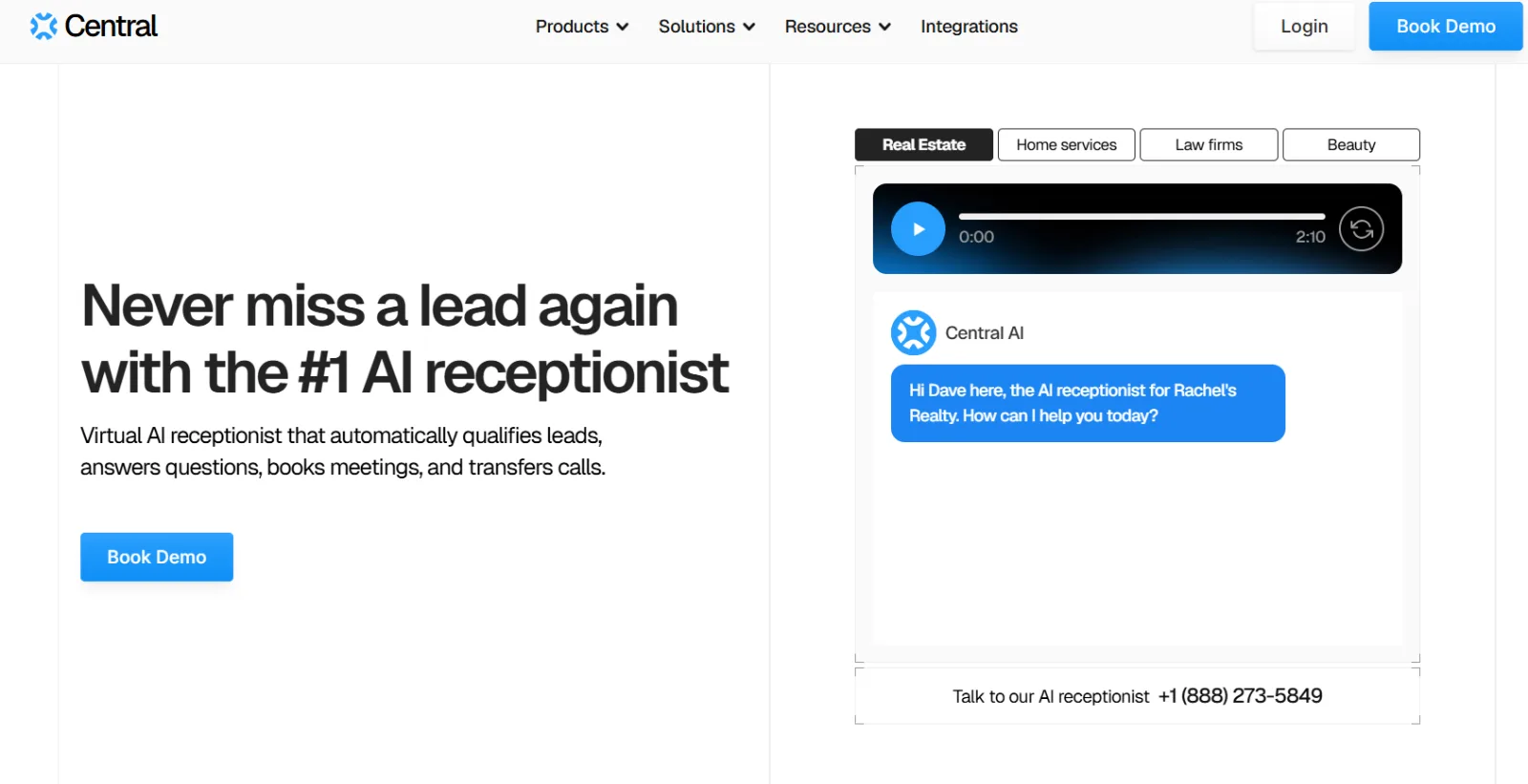
Central AI answers every inbound call 24/7 and captures the caller's name and number automatically so no patient inquiry gets lost. Setup is built around speed rather than engineering time: the platform trains itself from a practice's existing website and uploaded documents, extracting FAQs, pricing and policies without a custom configuration process.
On the call itself, Central AI checks availability and books directly onto the practice's calendar and escalates to a human whenever it hits a question it cannot answer or a caller asks for a person, though Central notes that transfer connects only if your virtual receptionist is available. After the call, it generates a summary and syncs it to the practice's CRM and its ticketing system auto-generates and prioritizes tickets from conversations, tracking them from pending through resolved.
Central AI speaks over 30 languages, includes a free built-in CRM, offers voice customization for accent and tone and connects with more than 6,000 tools through Zapier.Pricing starts at $89 a month for 90 calls, with a 10-day free trial. Human support and live receptionists are priced separately, and onboarding begins with a booked demo rather than instant signup.
On compliance, Central's Trust and Security page states the platform is ISO 27001:2022 certified and fully HIPAA compliant, and that Business Associate Agreements are executed with all customers handling protected health information. SOC 2 reports are available on request under NDA.
Scheduling runs through Cal.com, Calendly and Google Calendar. Central's healthcare page states the AI integrates with major EMR and EHR systems, pulling availability and booking appointments directly into patient charts. No specific systems are named, so a practice running Epic or eClinicalWorks should confirm the integration path before committing.
One point to confirm directly before signing. Central states it executes BAAs with all customers handling PHI, so request the document and confirm it covers call recordings and transcripts rather than the platform alone.
Best suited to solo practices and small groups that want a working receptionist quickly without developer involvement.
2. Retell AI
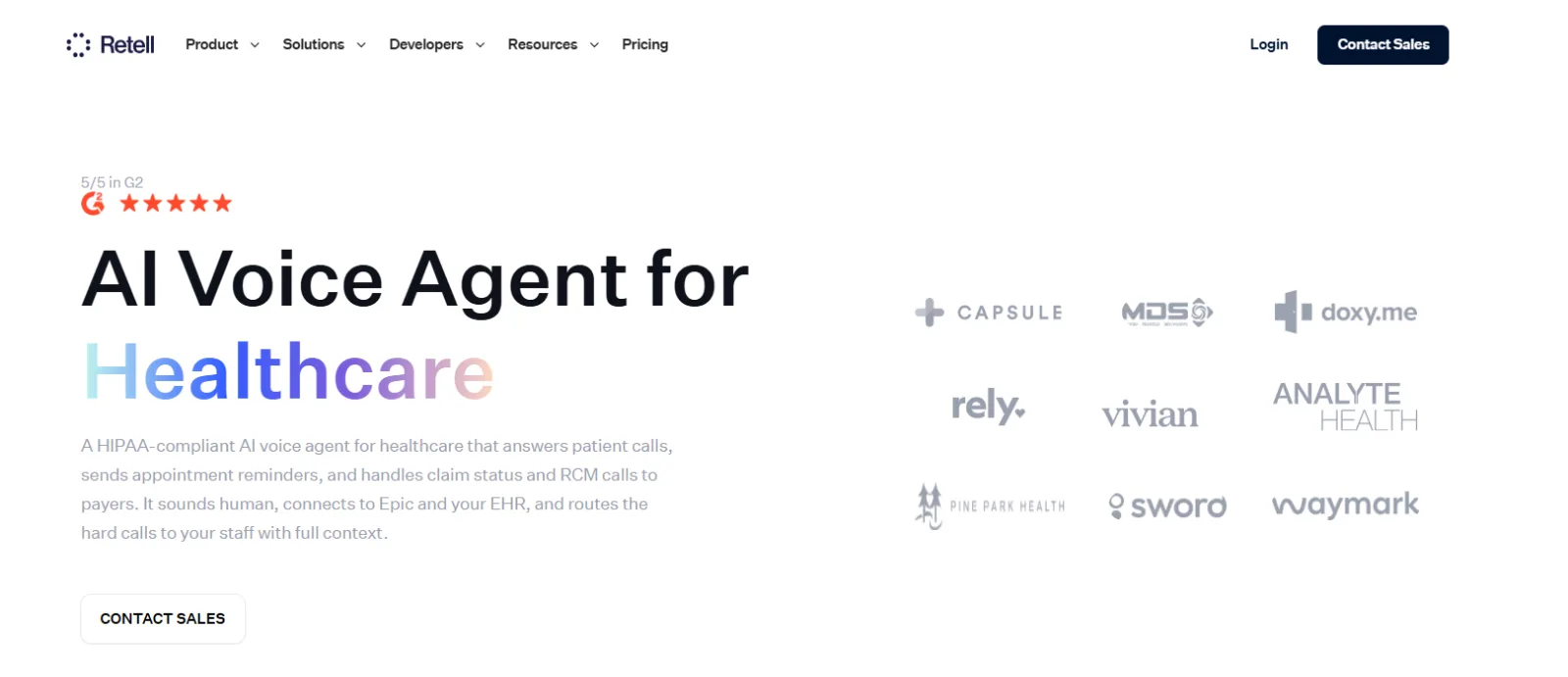
Retell AI is built voice-first rather than as a chatbot with voice added later, which shows up in its telephony handling and call quality. It signs a BAA on a self-serve basis at no additional fee, holds SOC 2 Type II certification, and enforces role-based access control, multi-factor authentication, and audit logging on every account.
Retell connects with Epic, OpenDental, Dentrix, ChiroTouch, and eClinicalWorks, and can navigate payer and clinic IVR systems to check claim status or pull refill information on a practice's behalf.
The tradeoff is architecture: Retell's standard pipeline processes speech through separate transcription, language model, and voice synthesis steps, which adds noticeable latency compared to platforms built as single-step audio processors.
3. Vapi
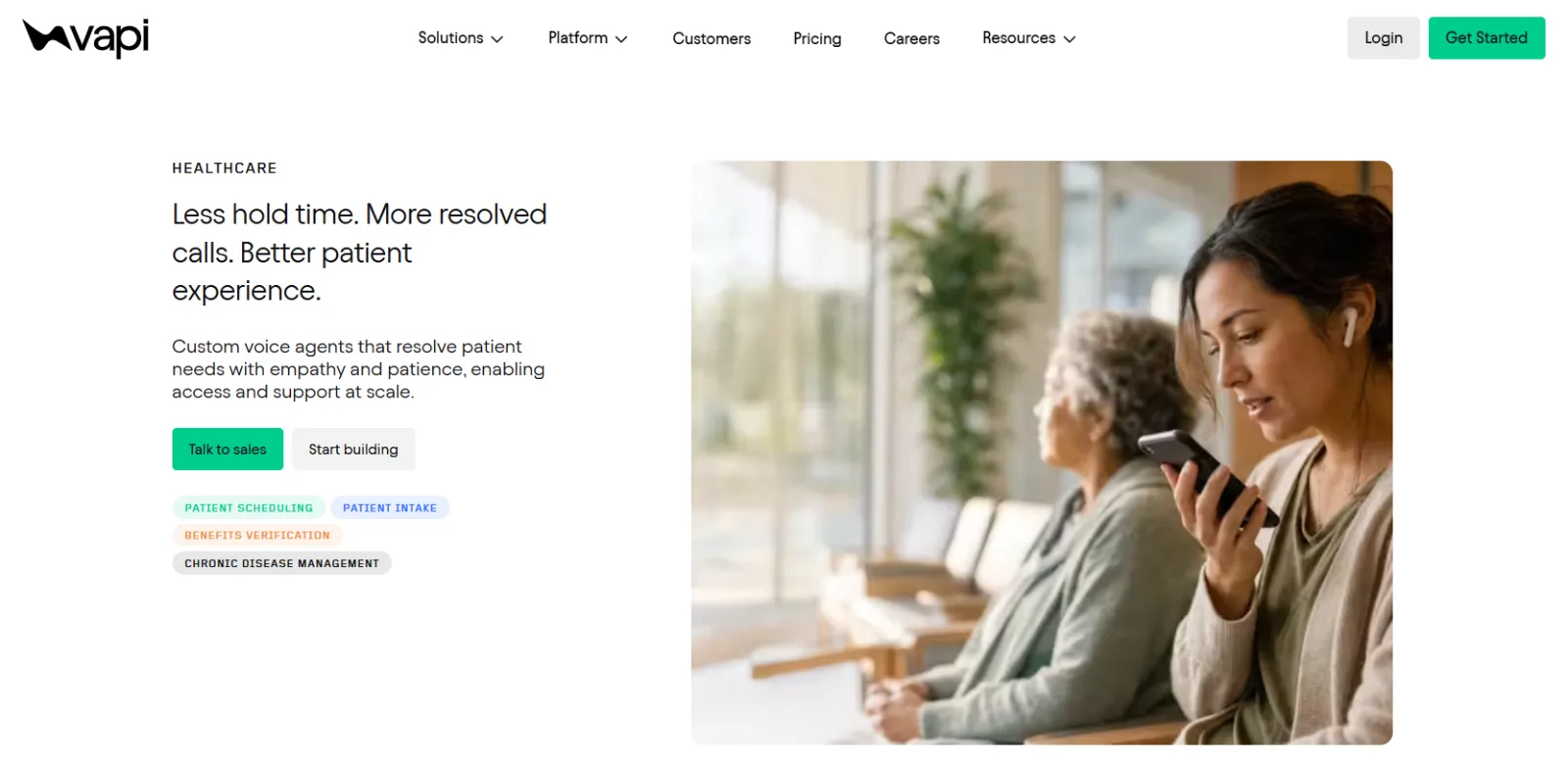
Vapi is a developer-oriented orchestration platform that lets teams choose their own speech-to-text, language model, and voice provider, then wires them into a working voice agent.
HIPAA compliance is not switched on by default. According to Vapi's own documentation, enabling it requires an Enterprise subscription or a separately purchased HIPAA add-on, a signed BAA and configuring every assistant to use only HIPAA-compliant providers from Vapi's approved list.
Vapi's documentation is also explicit that using HIPAA-eligible provider keys is not sufficient on its own. The organization remains responsible for ensuring PHI is not stored outside the compliant configuration and HIPAA mode is an organization-wide setting with no way to run a mix of compliant and non-compliant assistants.
That makes Vapi better suited to teams with in-house engineering resources than to a practice that wants a working receptionist without ongoing technical oversight.
4. Bland AI
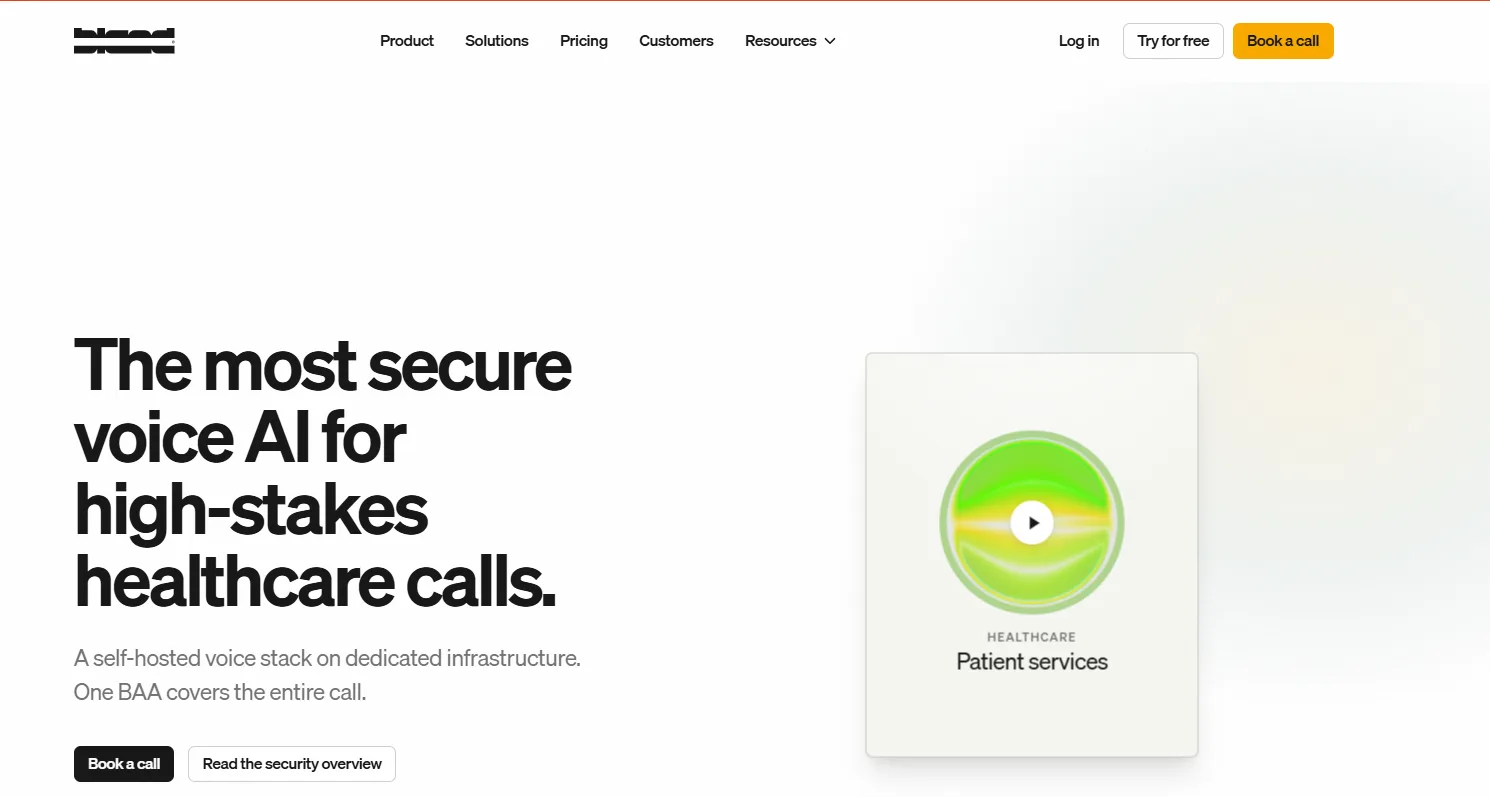
Bland AI runs its own speech-to-text, language model and voice synthesis on infrastructure it owns rather than assembling third-party services. A single BAA can therefore cover the entire call rather than a chain of separate vendor agreements.
Its healthcare page documents HIPAA compliance, SOC 2 Type II certification, PHI encryption, configurable data retention and audit logging directly.
Bland is often described as outbound-focused and its enterprise customer base does lean toward high-volume outbound work like eligibility verification and reminder campaigns. Its own healthcare materials demonstrate inbound patient-facing scenarios as well, though full BAA coverage appears more clearly established at the Enterprise tier than on the entry-level plan. Confirm this before committing.
5. Synthflow
Synthflow markets itself toward enterprise healthcare procurement and its certification list is broad: SOC 2, HIPAA, ISO 27001, PCI DSS and GDPR, with region-based hosting for organizations needing EU data residency alongside US coverage.
Synthflow's pricing page describes a single sales-led path, with packages scoped by its team around call volume, telephony, integrations, security and launch support rather than a published self-serve tier.
Practices still on legacy lines should scope the move from PSTN to VoIP into that conversation, since it determines which carrier sits inside the compliance perimeter.
For a health system or large multi-location group already running a formal procurement and compliance review, that structure is a reasonable fit.
For a solo practice evaluating options without first speaking to a sales team, Synthflow's terms cannot be confirmed without a direct conversation.
Head-to-Head Comparison: HIPAA-Compliant AI Receptionists for Medical Practices
| Feature | Central | Retell AI | Vapi | Bland AI | Synthflow |
|---|---|---|---|---|---|
| Published safeguards | HIPAA with BAA, ISO 27001:2022, SOC 2 on request | SOC 2 Type II, RBAC, MFA, audit logging | Depends on configured providers | SOC 2 Type II, encryption, retention controls, audit logging | SOC 2, ISO 27001, PCI DSS, GDPR |
| Setup | Demo-led, trains from website | Self-serve dashboard | Requires developer configuration | Enterprise onboarding | Sales-led onboarding |
| EHR Integration | Major EMR/EHR claimed, no systems named | Epic, OpenDental, Dentrix, eClinicalWorks | Not stated on docs pages | Via API, healthcare-specific deployments | Yes, healthcare vertical positioning |
| Architecture | Managed platform | Multi-step STT-LLM-TTS pipeline | Developer-assembled, multi-vendor | Full-stack, single-vendor | Multi-step, no-code builder |
What Does a HIPAA-Compliant AI Receptionist Cost?
Pricing in this category splits into two models and the split tracks closely with how compliance is handled.
Usage-based platforms like Retell and Vapi charge per minute, so cost scales with call volume rather than sitting fixed. Central AI runs a flat monthly rate and publishes its entry tier at $89 for 90 calls.
Enterprise-tier platforms generally do not publish healthcare pricing at all, because the BAA, security review and onboarding are scoped per customer. That is not evasiveness, it reflects the fact that compliance work has a real cost attached.
The number that matters is not the monthly fee but the fee at the tier where the BAA actually attaches. A platform advertising a low entry price that gates HIPAA coverage behind Enterprise pricing is not a cheap option for a medical practice, it is an option that does not apply.
Practices running separate lines for different departments or locations should also confirm how the receptionist handles multiple numbers, since per-number pricing can change the total materially.
Which Platform Actually Fits Which Type of Practice
The comparison above covers what each platform does. What it does not answer is which one fits a specific practice and that comes down less to features than to who implements and maintains the system day to day.
A solo practice or small group without dedicated IT support is generally better matched to a platform built for fast setup, which is where Central's website-trained onboarding and Retell's self-serve BAA both fit. Between the two, the deciding factor is usually whether the practice wants a broader business platform with CRM and ticketing built in or a voice-specific tool with named EHR integrations already in place.
A practice with in-house engineering resources gains real flexibility from Vapi's provider-agnostic approach, since it allows choosing specific models and voice providers rather than accepting a fixed stack. That same flexibility is a liability without someone dedicated to maintaining the configuration correctly.
A practice that wants a single vendor responsible for the entire voice pipeline is better matched to Bland's full-stack architecture. A large multi-location group or health system already running a formal procurement and security review is the clearest fit for Synthflow.
What to Verify Before You Sign
Start from the assumption that a homepage badge is not proof of anything. What actually protects a practice is a signed BAA in hand, and the specifics inside that document matter more than whether one exists at all.
-
Confirm whether the BAA covers call recordings and transcripts specifically, not just the core platform, since some agreements carve these out.
-
Ask which plan tier the BAA actually attaches to. Several platforms on this list gate full HIPAA compliance behind Enterprise pricing rather than including it by default.
-
Check whether every subprocessor in the call, the language model, the voice engine, and the telephony carrier, is covered under the same agreement or requires separate BAAs of its own.
-
Ask what happens to a call's data if it fails partway through, and whether that data is ever used to train the vendor's models.
-
Confirm the escalation path for urgent calls before going live, not after a real patient call needs it.
Under HHS guidance on business associate liability, a vendor handling PHI can be held directly accountable by federal regulators for specific compliance failures, independent of the practice itself. The BAA is not a formality between two parties, it defines what a regulator can enforce against the vendor if something goes wrong.
The Disclosure Question Most Comparisons Skip
HIPAA is not the only regulation in play. A growing number of US states now require businesses to disclose when a caller is interacting with an AI system rather than a person and healthcare tends to attract the closest scrutiny.
Several vendors market the fact that callers cannot tell they are speaking to AI. For a medical practice, that is a feature worth handling carefully rather than celebrating. Confirm that your platform can be configured to introduce itself as AI, check your own state's current requirements and document the decision either way.
Practices moving from legacy phone systems have a related question to settle, since the migration changes where call recordings are stored and which carrier sits inside the compliance perimeter.
Common Mistakes When Choosing an AI Receptionist for a Medical Practice
Assuming HIPAA compliance is included by default is the most common and costly mistake. On more than one platform in this comparison, full compliance is gated behind an Enterprise tier or an add-on that has to be configured before a single patient call touches the system.
Assuming every platform handles compliance architecture the same way is the second. Some vendors run the entire voice pipeline on infrastructure they own, while others assemble it from several third-party providers and that affects how many separate agreements need to be in place before PHI can legally touch the system.
It is also worth distinguishing an AI receptionist from a basic automated attendant, which routes calls through a menu without understanding what a caller needs. A menu-based system cannot handle patient intake, scheduling or triage the way a genuine AI receptionist can.
Conclusion
There is no universal best AI receptionist for every medical practice, since the right choice depends on call volume, how much technical setup a practice is willing to take on, and how the compliance architecture fits an existing workflow.
Central AI offers the fastest path to a working receptionist without developer involvement, and states that it executes BAAs with all customers handling PHI, while Retell and Bland run their compliance architecture directly rather than assembling it from third parties, and Vapi and Synthflow fit teams with either in-house engineering resources or an enterprise procurement process already in place.
Whichever platform ends up being the right fit, getting the actual BAA in writing, and confirming exactly what it covers, is the one step worth treating as non-negotiable before any real patient call goes through.
Frequently Asked Questions
1. Is any AI receptionist automatically HIPAA compliant?
No. HIPAA compliance depends on a signed Business Associate Agreement, encryption of PHI in transit and at rest, access controls, and audit logging, not a label on a vendor's website. Several platforms marketed as HIPAA compliant only include full coverage on specific, often more expensive, plan tiers.
2. Why do some platforms treat HIPAA compliance as a separate add-on rather than a default?
Full HIPAA compliance often requires additional infrastructure, such as restricted data storage, dedicated environments, or extra security review, which some vendors gate behind a specific plan tier or add-on rather than building into every account by default. It is worth confirming this directly with a vendor before assuming a standard plan already covers it.
3. What should a practice ask a vendor before signing, beyond whether they offer a BAA?
Ask specifically what the BAA covers, whether it extends to every subprocessor touching the call, and what plan tier that coverage actually requires. A vendor can genuinely offer a BAA while still gating full compliance behind a specific tier that a practice has not yet selected.
4. Can an AI receptionist actually integrate with a practice's EHR system?
Several platforms in this comparison connect with major EHR systems including Epic, OpenDental, Dentrix, and eClinicalWorks, though the depth of that integration, whether it can book directly into a chart versus just checking availability, varies by vendor and is worth confirming for your specific system before committing.